Friday, April 16, 2010

Secrets of a dog's life


Our house has a deck off the kitchen and livingroom that is a full story above our carport. When the weather is fine, we like to let Jack out on the deck during the day, with a baby-gate on the stairs to keep him from roaming. He likes to sit there watching our neighbor's dog play and our neighbor's chickens wandering in their yard.

This morning as I got into my car to go to work I caught him at the corner, watching me.
I think he wants to come with me.

Well, maybe not.

Small spaces for gardens


It's such a treat to tour great gardens that it inspires a fresh look at the garden at home. But what if you come back from viewing elegant vistas, broad paths, and rolling lawns to face the scrappy little urban patch that is your garden?

Several gardens featured on the Theodore Payne Foundation Native Plant Garden Tour this past weekend were small urban gardens, and they showed what can be accomplished in a small space. Take heart, urban gardeners. You can do a lot with your yard.


This small city lot in Mar Vista in West Los Angeles has a tiny front yard. The area north of the center walkway was planted twelve years ago, while the plantings bordering the driveway are more recent.


The homeowner has been able to completely do away with a traditional lawn. A mature manzantia (arctostaphylus sp.) with its beautiful cinnamon-brown bark is underplanted with low ceonathus, sage, and penstemons.


This planting shows how pretty even small spaces can be - with an assortment of coral bells (heuchera) beneath a hyptis emoryi with its grey textured leaves and small blue flowers.


The design of this back yard is simple as can be. Fenced in corrugated galvanized steel, the tiny yard includes a garage and office at the back. Gravel paves the flat space between office and house, punctuated by stepping stones. A deck extends from the house, low enough to forgo railings or stairs. In the graveled area, drought-tolerant shrubs including sage, manzanita, and ceonathus are planted beneath a palo verde tree.


This small Hollywood lot takes a similar stark modern approach to its design. Much of the lot is paved. In the front a wide plaza enclosed by low walls leads to the entry of the home. The rest of the front is mulched or graveled, with narrow plantings of deer grass that waft in the breeze and native rushes whose brownish seed pods add interest.


This West Los Angeles garden goes in the other direction. It crams a lot of plants into a small space. Here a magnificent fremontodendron is the centerpiece of the front yard. Surrounded by sage, monkeyflower and ceonathus, it thrives, raising hundreds of butterscotch-colored blossoms in the sun.


My photo doesn't do this magnificent plant justice. Here's a blossom, shown against the deep blue of ceonathus.

The gardener makes use of every space, including this 18" strip on the north side of the house, where heuchera and white Pacific Coast hybrid iris bloom amid ferns.

Only slightly bigger, this front garden makes use of the sculptural trunk of a mature jacaranda, nestling flowering plants beneath. A path paved with decomposed granite winds between mulched plantings of pitcher sage, PC iris, flowering currants, mahonias and other shrubs. The billowing shrubs of the perimeter conceal secret oases where a bench and a birdbath offer quiet spots for contemplation.

This Culver City gardener has taken a sensible approach. The original foundation plantings and mature trees remain, as do groundcover of jasmine. The lawn, however, is gone, replaced by a curved plaza of decomposed granite bordered by planting beds that feature casual annuals and shade-loving shrubs.


The sunny backyard features a great specimen century plant, or agave that is blooming this year, surrounded by colorful annuals, penstemons and sages. Birds and butterflies love the plantings in this back garden. A neighboring yard's abundant morning glories show how "borrowed views" can add color and interest to tiny gardens.


This planting demonstrates how even the tiniest sliver of space can become a garden. In the space beneath a hose bib, a mahonia - its glossy evergreen leaves attractive against the golden stucco wall - a clump of maroon ornamental grass and chalky duddleyas combine together in a perfect composition.

These gardeners have all managed to create gardens of beauty and interest in small city yards. They've made livable yet private outdoor spaces to enjoy. In the bargain, they've elmininated water-hungry lawns, provided attractions to birds and butterflies, and cut their maintenance tasks down to the minimum.


Pretty good for the city, wouldn't you say?

Wednesday, April 14, 2010

Small potatoes

There's not much going on these days, and I feel stale and uninspired, especially at work. But just recently I was presented with an opportunity - a cross-disciplinary training program for people who want to pursue upper management positions. So I'm applying - the application is due in a couple of weeks.

Among the questions is - Name 5 skills you possess that would make you a good candidate for this program. Provide examples of why you think each skill would be an asset for you while in this program.

Wow. How would you answer that?

Wish me luck!

Tuesday, April 13, 2010

Why not?


As long as you're painting an Aztec-themed mural on the wall of a hardware store, you might as well

include a headphone-wearing penguin in the picture. As long as he's wearing a tuxedo.


Why not?

Sunday, April 11, 2010

Casa Fantastica!


When you think about garden tours, you usually think about seeing new sights, wonderful new inspirations, getting new ideas. But one of the truly wonderful aspects of gardening is that it's an exercise in change. So it was a thrill for me that one of the stops on the Theodore Payne Foundation's Native Plant Garden Tour was a repeat from last year - I would have a chance to see how it fared over the last year.

The house in 2009

The garden surrounds a magnificent old house in the section of Los Angeles known as Mid-City. Huge homes built just past the beginning of the 20th century line broad avenues. The neighboring houses are in various stages of repair - some restored, some dilapidated, and others sporting graceless alterations that took place in an earlier era.

According to the owners, this house was in a state of deterioration when they found it, but that was a blessing, for it had not suffered the indignity of "improvements" in past decades. The house was painstakingly remodeled, and then the grounds were landscaped to create a low-water-use garden using native plants.

Both the house and the gardening remodel uncovered a lot of cumbersome debris, and rather than junk it all, the clever gardeners decided to use these artifacts as garden sculpture. Instead of classical statuary, the garden features the undulating forms of rusting old steam radiators and iron cisterns and tanks. Because of this junkyard decor, the home's creators have dubbed the place "Casa Apocalyptica."

Chunks of broken concrete create retaining walls for monkeyflower bushes to sprawl over. Rusted trailer hitches are buried in a kind of constellation in a bermed garden bed full of annual California poppies and baby-blue-eyes.


Here, a cluster of old tanks, chunks of sidewalk, and rebar form a sculptural note beneath a silvery olive tree and the raised flower spikes of echium "Pride of Madiera."


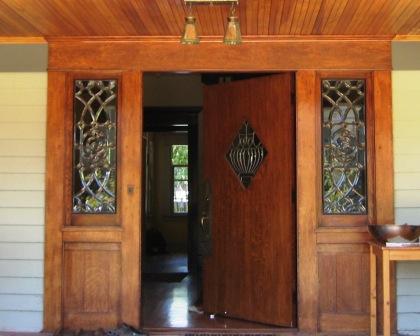
This year, the owners graciously opened the first floor of the house to us, showing off the magnificent Arts & Crafts dining room and the beveled glass windows. We walked through the spacious kitchen and out onto a deck space shaded by a pergola, where an outdoor dining area overlooked a swimming pool.


Most of the backyard was hardscaped with concrete pavement, though garden beds surround the side and back. There were cozy nooks for sitting, dining, and lounging, all cleverly tucked into private garden rooms by careful plantings or the placement of containers. The back of the property was screened by a wall of tall bamboo.


A magnificent fountain trickled into a large free-standing pool, surrounded by broad brick walls that were perfect to sit on. In the water, huge koi swam. Last year, the tank had been new and bare - this year its plantings were lush and its brick walls were softened by climbing vines.


A screen of espaliered fruit trees separated the swimming pool area from a small dining space off the main house. In addition to fruit trees, a passionflower vine twined among the cables, and today it was magnificently in bloom.

Although the plantings look lush, the use of pavement to shape and define the space makes maintenance easy. This is a view of the back of the house. The larger pergola leads to the kitchen. Above it is a sleeping porch off the second floor - sleeping porches were very popular during the Arts & Crafts era, as Southern California doctors promoted breathing fresh air while sleeping for improved health.

My favorite plantings are in the front yard, though, and here is where you can see the greatest change from last year.

The front garden in 2009

The front yard had been cleared of its older lawn, and gentle berms had been created, and planted with sages, ceanothus, penstemons, and artemisia. What last year was a promising start

The same spot now. Click to "embiggen"

Is this year a full and fabulous landscape. A magnificent clump of white sage, Salvia apiania, rises up over the oddly sculptural artifact of an old steam radiator. In the hollow formed by rocks and boulders, a blaze of bright California poppy - a specific variety selected for its deep orange hue - draws the eye.

Monkeyflower

The shrubby native monkeyflower, with its flowers of tender apricot, is at the left. Selected varieties of monkeyflower, in shades of cherry or ruddy vermillion, are planted elswhere in the yard.

At the north side of the central walk, bush lupine and a great spiky ornamental grass range with yellow tree poppies and deer bush.

This garden visitor seems to appreciate the multiple hues of a low-growing native penstemon

with flowers that fade from deep sky blue to violet.

Here's another view of the front garden this year, with the plantings filled out lushly. Compare this view to the one from 2009 at the top of this post.

It's always a rare privilege to be invited into a private garden to see another gardener's work. But it's even more wonderful to be invited back to see how the gardener's vision has developed. I'm already longing for 2011 to see this garden again.

Saturday, April 10, 2010

Cool grafitti

Day One of the Theodore Payne Foundation Native Plant Garden Tour was fantastic. I saw 12 gardens in 5 hours. I'm exhausted. And tomorrow, there's more!

Meanwhile, I saw this really cool bit of grafitti in the West Adams district of Los Angeles. Bzzzzz!

Friday, April 9, 2010

Spring sandal choice

Well, it's time to make a choice about spring sandals. I've been intrigued by the new "gladiator" style sandals, so I ordered 2 pair from a mail-order house, to choose one pair and send the other back.

Sandal A is on the left. It's a matte black leather with small silver-metal inserts on the straps. Sandal B is on the right. The color was stated as "Ebony" but it is really a very dark brown. I had wanted black, but I don't think I mind deep brown. Both pair cost the same. They both fit well. Both have a good heel height - 2".

While photographing this, I have come to realize that I don't have a decent full-length mirror with good lighting. Bear with my crappy photos.


Here's Sandal A. I like the fact that they show more toe - showing off the pedicure I really must get. But the ankle straps gape, and will need to be tightened if I keep them. The styling is a bit informal. The "U" shaped design right at the ankle is a little odd - catches the eye, but I'm not sure it's flattering.

Another view of Sandal A, above.


Here's Sandal B.
Another view. Sandal B's leather is smoother, with a bit of sheen. I like the grommets and studs. The double strap up the front of the foot is more slimming, and the ankle strap fits properly. On the other hand, the zipper at the heel has a large pull that jingles annoyingly when I walk.


Sandal B again. They're comfy. Sorry again about the crappy photos.

I'm inclined to go for Sandal B, if I keep a pair at all. It's a little difficult to figure out what to wear with gladiator sandals. I'm wearing a soft drapey charcoal knit skirt today. Perhaps khaki capris would look good - but that would mean I have to buy some. Jeans? Skirts? Dresses?

Are gladiator sandals passe by now in 2010? My son's 21 year old girlfriend was wearing them in 2008.

Should I go for Sandal A, Sandal B, or send them both back? What do you think?

Thematic Photographic - Goodbye Winter

Each week Carmi at Written, Inc. has challenged readers with a theme for photographic inspiration. This week the photographic challenge continues with the theme "Goodbye Winter."


Here in Southern California, we've said goodbye to winter a few months ago. But back in January, things were still awakening. Among them, this vigorous rosy-tinged shoot pushing up through the soil with its leaves furled like a fist. It's our California mountain native peony, Paeonia californicus.


The leaves open up, the stalk lengthens, and a nodding bud emerges.

It's a flower so shy you can only look into it if you turn it up to face you. These flowers bid winter farewell - by saying Hello to spring.

Thursday, April 8, 2010

Roadside sight

There's something about Topanga - you see a lot of interesting things in our canyon that you might not see elsewhere. It could be because there's only one road in, and everything that comes here has to come the same way. Or it could be because it's always been a place that's attracted unusual people.

Last weekend while [The Man I Love] was driving I turned round in my seat to see an incredible sight - steel wings lifted to the sky, hands out-reaching, a glassy sphere -- What?

"Hey did you see that?"

"What?"

"Some kind of sculpture on a car, I think. We went by so fast."

The next day we saw it somewhere else, by the lumber yard. Yesterday going to work, I saw it down below the S-curves. On the way home, it was parked on the side of the road by the creek.

This morning on my way to work, I had to stop. It was parked, and empty. A skeletal figure, large as life, rusted steel, is fastened to the back of an SUV, poised as though leaping, one arm raised up holding a filigreed sphere, the other a golden chalice.

The driver's seat was empty. A curtain hid the cargo space - was the car abandoned or was someone sleeping? "Hello?" I said. No answer. I took a photo of the life-size eagle mounted on the roof of the car. I waited a little while. Then I got back in my car and went to work.

The next time I see his car, I'll try to stop again and see if I can learn more.

If you visit the website on the sign carried by the car, you will know everything I know about this so far.