Monday, April 11, 2011

London Calling

Stone sphinx at Powis Castle Garden, photo taken in 1998 on our first trip

In the months ahead, we are going to be travelling to visit our son, who's going to school in London, England.

I've been to London twice before, but not in the part of town where we'll be this time. Our son's school is in southeast London, and the flat we're renting is in Wapping.

Wapping is a riverbank neighborhood whose old historic character was wiped out in the 19th century by the building of huge dockworks and warehouses, and then again in the Blitz by bombs. In the 1980s it was the scene of fierce labor protests against Rupert Murdoch's News International printing plant. But now - like many once derelict urban areas - it is said to be home to a residential real estate boom.

I only know this from Wikipedia - I've never been there. It's not the part of London I am familiar with. During our previous stays we were in Bayswater, Kensington, and Notting Hill.

In addition to exploring the city, we'll have time for day-trips, too, in the surrounding countryside. I'd love to see some gardens, and maybe visit the seaside resort of Brighton.

So, readers and friends, Londoners and travelers - tell me. What should we put on our list of Things Not to Be Missed in London and in England?

Sunday, April 10, 2011

Dining Alone - A dark street

I'm pretty adventurous, and I think I have some street smarts. As a young woman I lived in some pretty scarey sections of New York City, and because of my job, I often came home late at night or in the early hours of the morning. I feel pretty confident exploring strange cities on my own.

But I also have a good "spidey sense" that I heed when it comes over me.
On our recent trip to New Orleans, [The Man I Love] had an evening meeting, and I was on my own. I had a short list of restaurants I wanted to try, and thought I'd choose one for a solo dinner on a Monday night.

Monday nights are tough for dining in most cities, including New Orleans, but Gautreau's was open. I made a reservation for one, at 7:00 pm.

Sadly, New Orleans has a crime problem, and tourists are typically warned to beware. But Gautreau's is located in Uptown, on Soniat Street, which isn't one of the neighborhoods you hear bad things about.

In late February, it was twilight when I boarded the St. Charles streetcar. I asked the driver to let me know what stop was closest to Soniat Street. He told me it was between stops, but he'd let me off just a block before.

As I crossed St. Charles Avenue and turned to watch, two streetcars passed one another in the dusk.

It was a pretty evening. I turned off the Avenue and walked north. I passed old homes behind brick-piered fences, shaded by old spreading oaks, and looked at the address numbers.


If you look closely at this tile-marked intersection, you'll see what I missed. It was right in front of me.

I'd read that Gautreau's was located in a quiet neighborhood, and it was tricky to find, since it didn't have a sign. But when I got to what should have been the right number, it didn't seem right.

I went on. At the corner on Daneel Street, a large industrial building loomed in the darkness. On the far corner, there was a building like a gym, and from within came the sounds of basketballs bouncing on hardwood floors, and shouting youths. Beyond were asphalt parking lots, fenced with barbed wire. It didn't seem right.

And then I looked at the street sign. I wasn't on Soniat Street. I was on Dufosset Street. What a dummy I was! I hadn't even looked at the sign when I turned off St. Charles.

Well. I knew it had to be just a block or two one way or the other. But which way? I tell you, I don't know how I felt exactly. I wasn't frightened, but some of the reviews had mentioned things like "take a cab" and "it's a sketchy neighborhood." Mostly I just felt like I wanted to know the quickest way, because I didn't want to arrive late for my reservation.

So as I stood, briefly, on the corner of Dufosset and Daneel, wondering if I should pull my cellphone out of my bag and check the Yelp listing map, I realized that, parked on the curb at Daneel, pointing toward the basketball gym, was a NOPD patrol car, idling, with an officer at the wheel.

I crossed the street and walked up to the passengers side - the window was open - and said, "Excuse me, sir, can you tell me which direction is Soniat Street?"

Let me say that my experience with police officers is a positive yet pragmatic one. I have worked together with them in crowd control situations many times, and have never encountered them personally in a negative way. I'm respectful, and appreciate their work. On the other hand, I've learned - I've been on the receiving end, professionally - that sometimes police officers think of "civilians" as lesser beings, folks who just don't know the whole picture. (As a member of another subgroup that thinks the same, I can empathize.)

This officer said to me, flatly, "I wouldn't know." Now - excuse me - but why would a police officer not know the streets where he was on patrol?

That was the moment that my spidey-sense, which I mentioned before, began to flare like a strobe light. Was he on a stake-out? Was something going down? Was I in the wrong place? Did he think I was suspicious? I felt a flutter of unease.

"Okay," I said, "thanks!" and I hitched my bag up higher on my shoulder and kept walking, and fortunately I had turned in the right direction, for there was Soniat Street at the next corner.

And there was Gautreau's. Gautreau's is a small restaurant, in an historic building that was once a pharmacy. It's often described in reviews as a "jewel box" of a place, with an ornate tin ceiling, an antique apothecary case housing the bar, and pretty trompe d'oeil painted walls. It has a superb chef, and has received rave reviews for its food.

As I sat at my single table in the corner, waiting for my heartbeat to slow, I sipped at an apertif of Lillet blanc on the rocks with a twist. A part of twelve or so business-people - dressed in suits and dressy dresses - were assembled at a table nearby and were loudly celebrating some corporate achievement. At other tables, couples sat in the amber candlelight.

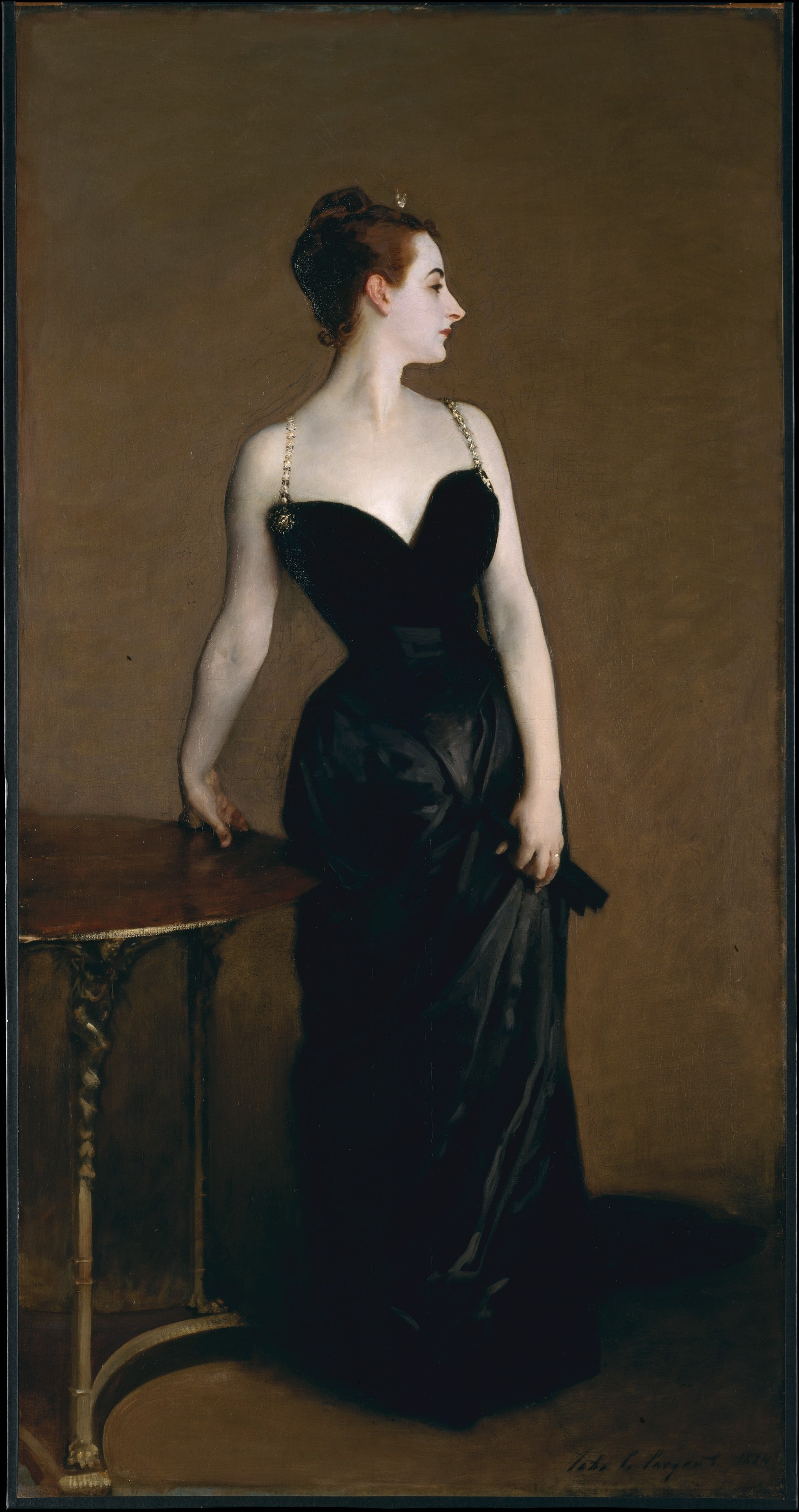
The restaurant is named after Virginie Amélie Avegno Gautreau, who was an ancestor of its founder and first chef, Ann Russell Avegno. A Louisiana Creole girl, she was the daughter of a Confederate general who moved with her mother to Paris at the age of eight. When she grew up she married a banker and became notorious for her beauty, elegance and love affairs. Her portrait was painted by John Singer Sargent in 1884 - and it shocked the art world with its sensuality.

A print of the famous painting hangs in an alcove just behind the hostess station at Gautreau's.

It was unsettling to move from the dark immediacy of the streets into this lush, protected, elitist refuge. Between the cheerfulness of the large party, and the intimacy of the romantic couples, I felt out of place - which is rare for me.

I ordered a meal. I ate. I savored each bite, each sip. I even had dessert - something I rarely do. It cost quite a lot. When I was ready to go, I asked the waiter to call me a cab.

It's all a blur to me. I couldn't tell you what I ate. Scallops, I think. The only vivid memory I have is of the journey there.

I wanted to check my facts after coming away from this experience. Was I right to feel nervous? So I checked the archives of the Times-Picayune newspaper, and the local neighborhood website for this area both going back a year or so, and found that, while there were occasional crimes as there are in every city, this wasn't all that bad a neighborhood, statistically.

In retrospect, I really wonder about the officer I encountered. I think it would be quite obvious that a middle aged white lady with a northern accent in that neighborhood around dinner time was looking for Gautreau's restaurant - a pretty famous tourist attraction. He could easily have directed me right to its door, and I would have come away with a memory of his charming courtesy. He was probably just having a bad night.

Dining Alone is often an unexpected adventure - have you ever felt unsafe going to a restaurant by yourself?

Saturday, April 9, 2011

Pink Saturday - Pinks

Pink Saturday - Beverly at the blog "How Sweet the Sound" hosts Pink Saturday. Let the color pink inspire you!

We call them "pinks" - these bright, intricate, cheerful flowers. A nice homey name for a humble cottage-garden flower. But their botanical name grants them an uncommon nobility. The name Dianthus comes from the Greek "dios" - meaning God - and "anthos" - flower. What did this pretty little flower do to earn the name of Flower of the Gods?


Perhaps it was the heavenly scent. Dianthus caryophyllus is the species ancestor of the familiar carnation, with its spicy clove scent. The Crusaders brought them to France and then to England, where they were called "gillyflowers" - a corruption of caryophyllus - and "sops in wine" because the blooms were used to flavor wine.


Dianthus plumarius is the hardy perennial garden pink, and Dianthus chinensis is the annual pink. Other commonly grown pinks are small rockery alpine plants, and the bunch-flowered biennial Sweet William, or Dianthus barbatus.


Dianthus flowers come in a range of colors from pure white to deepest purple, with a few yellow species, which can be bred to introduce salmon, orange, and coral colors. Their petals can be solid or can be intricately marked, with brushmarks of color, speckles, stripes, tipped edges called "picotees" or broad bars called "flakes." Some have just a ring of different color at the center, called an "eye." Others are called "laced" for markings that have almost a doily-like effect.


Dianthus are easily propagated from seed, and because they hybridize across species, the variations can be fascinating. They can also be propagated vegetatively from cuttings or division, so once you find an interesting variety, you can keep growing it and share it with other gardeners.


Because of this, there are many varieties grown today that were named decades, even centuries ago. Some English named varieties date from the 17th century.

I love the stripings, brush marks and speckles patterned on the petals of these China pinks. These easy annuals can be grown in mild southern winters as pretty container plants.


The characteristic all pinks have in common is - their PINKS. The verb "to pink" dates from the 14th century, and it means "to decorate with a perforated pattern."

Members of the genus Dianthus feature petals that are notched, frilled, jagged and sawtoothed just as if they'd been cut out with pinking shears.


In fact, the color PINK was actually named after Dianthuses - not the other way around!

Something to think about on a Pink Saturday.

Friday, April 8, 2011

FAD Friday

Diving Duck by Ohara Shoson (1877 - 1945)

Oh fuck! I almost forgot it's Fuck-a-duck Friday! Sometimes I just don't know which end is up!

How's your week been?

Thursday, April 7, 2011

Weekly Jack - the scamp

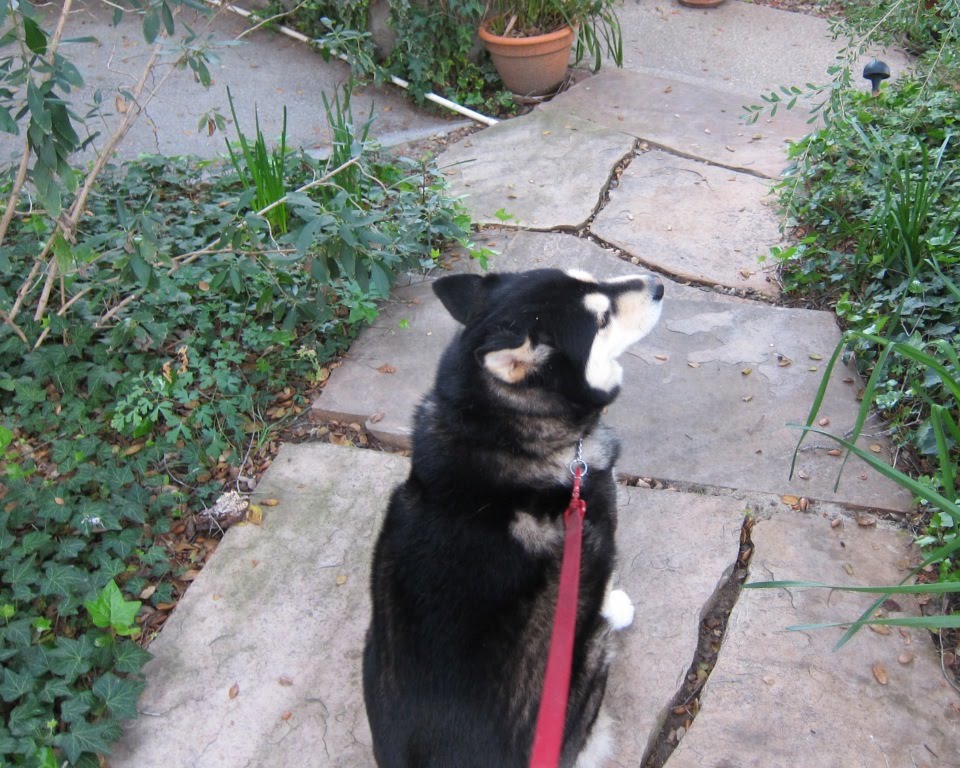
Jack is a real funny guy. When we finish our morning walk, he always wants to dash back in the house by himself. When we start down the steps, he turns as if to say, "Hurry up, won't you?"
Sometimes I have to make him sit pretty so he doesn't pull me.
When I do, you can almost see the tense energy as he waits with his ears turned back.

I make him sit again. And then - I let go of the leash and he bounds up the steps.
Where he waits at the door. He sits pretty while I slip off his chain collar. As soon as I open the door he noses past it inside and RUNS into the living room, and around the kitchen, his claws clattering on the floor, and then he turns the corner and LEAPS up the little carpeted stairs into the bedroom hallway, turns around in a circle twice, then FLIES back down the stairs, into the living room and finally lies down in front of his dinner bowl.


He's a scamp.

Tuesday, April 5, 2011

First rose of the season

This is the old China rose, "Eugene de Beauharnais," and it's the first rose to bloom in my garden this year.

It is said to date from 1838, although there is now some talk that the rose sold as "Eugene de Beauharnais" is really a Bourbon called "Le Grande Capitaine."

It's a low-growing shrub - mine is being swamped by a nearby Gaura lindheimeri "Siskyou Pink." It opens fully double, quartered blossoms a clear cherry red, and then the petals age to violet. It's scent is super-strong, "old-rose" and quite intoxicating.

For me, it's a weak and spindly plant wholly justified by its amazing scent and intriguing color. It blooms all year long - well, it starts early and ends late, but there are periods of no bloom in between.

It's named after Napoleon's stepson - the child of Empress Josephine and her first husband, Alexandre the Vicomte de Beauharnais. He was quite a military hero, and his step-father appointed him to several duchys and various other noble offices. He married a Bavarian princess and had plenty of kids who married a bunch of other European royals.

He's pretty happy here in my garden, despite the gaura. I think I'll keep him.

Monday, April 4, 2011

Dining Alone - The sushi bar

Hiroshige - "Bowl of Sushi" 19th century

If you're not familiar with Japanese cuisine, the sushi bar might seem challenging. But a sushi bar is a place where anyone can feel comfortable dining alone. Except you're actually not alone. When you sit at the sushi bar, you are in a relationship with a true artist of food - the sushi chef, or itamae.

Los Angeles is home to many trendy sushi bars, where you can get fabulous concoctions and fusion-inspired combinations, complete with grilled pineapples, waving insect antennae crafted from carrots, mayonnaise-based sauces and fried fish skeletons - but Hide Sushi on Sawtelle Boulevard isn't one of them.

It's just a small neighborhood joint, simple and friendly. There are about eight chairs at the sushi bar, and a handful of tables in the small room. Have a seat at the sushi bar. Hide Sushi has three chefs working during a busy weekend lunch hour.

When the hostess seats you, she offers a warm damp towel. This is to clean your hands. Do so, and then fold the towel and place it so that you can use it again to wipe your fingers while you eat. You order hot food, drinks, soup, etc. from the waitress. You order sushi and sashimi from the sushi chef. That's the way it works.

The sushi bar has a raised shelf above the main part of the table. The chef will put a plate - usually a rectangular platter - on this shelf, and upon it you'll find a thimble-sized nub of green wasabi and a flower-sized cluster of finely sliced pickled ginger. Be patient. Take your time. The itamae may be working on someone else's order.

I usually watch politely as he works, then wait for a subtle signal like a nod, or eye contact. You can ask for something you like. Or you can ask for what he recommends. What's good? What's in fresh today? If you wish, you can ask for omakase or chef's choice, which means you put yourself in his hands. He may ask you what you like, or if there's something you don't like.

If you want a long and varied meal, start with sashimi - this is simply raw fish, sliced and served without rice. Sometimes it will come with a simple sauce or flavored oil, or a sprinkling of herbs like scallions or shizo leaf. You eat sashimi with chopsticks. You can get something called chirashi-sushi that is sashimi served on top of sushi rice in a bowl.

The chef will place the sushi on the platter. Keep the platter on the upper shelf for his convenience. You may be given another plate to keep in front of you - or he may serve some kinds on their own platter, especially if they are served with sauce.

"Sushi" means the rice, not the fish. The rice is flavored with vinegar, and it's served with toppings, fillings, or condiments. There are mainly four different styles.

Tuna, yellowtail and octopus nigirizushi and cucumber, oshinko and pickled plum makizushi

Nigirizushi
is rice pressed into an oblong about the size of your thumb. A slice of fish or seafood is laid on top of it - often with a bit of wasabi, or the grated root of a plant similar to horseradish. Nigirizushi is usually served two pieces to the order.

Makizushi
is made by lining a sheet of dried seaweed, or nori, with rice, topping it with fillings, and then rolling it up into a tight cylinder. The cylinder is then cut into bit-size pieces - an order may have five or six pieces. You can have small maki, with just one filling, or you can have larger maki - futomaki - made with an assortment of fillers. California rolls are a kind of futomaki.

Gunkanmaki
(or battleship roll) - is similar to nigirizushi, with a pressed oval of rice topped with seafood, but it's wrapped with a collar of nori to help enclose a topping that's loose - like fish eggs - or soft, like sea urchin.

Temaki are also called handrolls. A sheet of nori is rolled into a cone, and filled up with ingredients like an ice-cream cone.

If you worry about it, the etiquette of eating sushi is somewhat daunting. It's good to know what NOT to do, that might offend the chef. But the rules are pretty simple, and in Los Angeles today, I think most sushi chefs have seen just about anything, and are pretty tolerant.

At Hide Sushi, the chef who served me was a dignified and quiet man with a nice smile, and it would have pained me to be impolite to him. And while I'm too tongue-tied to speak to him in the few Japanese phrases I know, I do try to remember these basic steps:

1) Don't scrape your chopsticks together as though to rub off splinters. This implies the chopsticks are cheap, so it's an insult.

2) Pour a little soy sauce in the dish, but don't mix wasabi in it. The chef has flavored your sushi as he intended, so trust him. If you find you'd like more wasabi on the sushi, ask the chef to put more on the next piece he makes for you.

3) Dip the fish side into the soy, not the rice side.

4) It's OK to eat with your fingers, or with chopsticks. I use my fingers.

5) Try to eat the sushi in one bite - or if you have to eat it in two bites, do so at once, don't put a bitten-in-half piece back on the platter. I'm told American sushi tends to be bigger than that served in Japan. I have to take two bites for most, except the small maki.

The pickled ginger is meant to be a palate cleanser between different flavors. I take a tiny sliver with my chopsticks, and I love the spicy taste.

L to R top: Saba (mackerel), Sake (salmon), Ebi (shrimp) nigirizushi. Bottom: Maguro (tuna), Yellowtail nigirizushi, Tobiko gunkanmaki

I like simple sushi - I don't generally go in for the fancy rolls. I like plain good fish like fatty tuna, albacore, and yellowtail. I also like the salty, strong-tasting mackerel, called saba in Japanese. I also like scallops, and ankimo (or monkfish liver), and tobiko, or flying fish roe with tiny bright red eggs that crunch between my teeth. I'm not a fan of sea urchin, and while I like octopus all right I have hard time chewing it. One of my favorite maki rolls is oshinko-maki, which is just pickled daikon - I love its odd taste and its vegetable crunch.

Cherry blossoms on the sidewalk in front of Hide Sushi

The simple and traditional fare served at Hide Sushi makes me remember when I first ate sushi with my dad, in New York City. I lived in the Village and worked in dingy lofts on the Lower East Side doing theatre, and my dad commuted into town from New Jersey to work for corporate clients as a consultant. Sometimes he'd invite me to lunch. The part of town where he worked was filled with Japanese restaurants and ramen shops, and sushi shops. It was the 1970s, but in Manhattan, on Third Avenue in midtown, no one was making California rolls.

I never sat at a sushi bar with Dad, we always sat at the dining tables. I don't know, now, whether he sat at the bar when he visited these restaurants alone. I like to think that he did - he was exactly the kind of person who would have enjoyed the polite, somewhat ritualized relationship between customer and sushi chef.

Sunday, April 3, 2011

In bloom again


It's another year, another spring, and the Pacific Coast Hybrid Iris are in bloom in my garden again.

I just can't get enough of them.


Golden yellow veined with brown.


Violet, with a yellow throat.

These beauties are bred from our native Douglas iris, and they're tough. They're happy in the dry shade under our native oak trees.

Leaping into spring


The delicate arching stem of the fairy-wand flower - Dierama pulcherrimum - frames our leaping pig wind vane. Happy Spring!