Showing posts with label Million Dollar Theatre. Show all posts

Thursday, December 16, 2010

Hidden Treasures

When I recently visited the Million Dollar Theatre, Sid Grauman's pioneering movie palace in downtown Los Angeles, I knew from a previous visit that the lobby and foyer had been remodeled sometime in the 1950s - as many old theatres were, it was updated, "streamlined" or modernized to compete with television.


What I didn't know was what had been there before - and what's still there behind it all.

Designer William Lee Woollett's decor scheme was not just intended to mimic a classic historical style - it was intended to create an atmosphere that would engage the audience, not just on the superficial level, but also subliminally - even spiritually.

Roberta B. Thudichum, a design critic writing in the journal "The International Studio" in 1919 writes rather breathlessly how Woollett received the commission. Newly relocated to Southern California, he dreamed of
some medium wherein he might portray, in a manner hitherto unaccomplished, a spiritual creation of the varied phases of American life. At the psychological moment a request came for him to draw the plans for the architect of this theatre. He accepted at once, not knowing who might develop his ideas or ruin them, but leaving every other interest in the hope that his dream in the abstract of some thing different from the overworked modes of the day might materialise in the concrete.
Of course, according to the article, it did. He and his patron, Sid Gruman, were on the same wavelength. Woollett was allowed to design the interior, all the furnishings and even paint the fantastic murals adorning the theatre walls.

It was an entirely new take on design in the realm of commercial architecture. The reviewer goes a little over the top in describing how singular this was:
It is conceded to be the first to symbolise the new America emerging from its baptism of blood, proud of the past, fearless of the future, joyously singing the song of the New Race, the New Peace—World Democracy.
Woollett's willingness to mix and match different architectural styles was a unique approach and somewhat scandalous:

Out of the arts and architectures of the past, out of the melting pot of the ages the creator has moulded from clay, colour and stone a castle beyond the beauty of dreams, ultra modern yet without the blatant marks of a nouveau genre, mellow in tone and texture and harmonious throughout. Those whose sensibilities are attuned to the conventionalised forms of the old schools naturally revolt at the daring thing which Mr. Woollett has done—marrying the new and old with its violent contrasts of classic Greek and richly ornate Chirreguesque...Mr. Woollett maintains that architecture is a vehicle for the translation of abstract values—that it should not be merely the trekking of historical scenes across one's vision; that details should be used for their psychological significance not for their correctness in any one style.
Image from "The International Studio" volume 69, November 1919 of the hidden "King of the Golden River" mural at the Million Dollar Theatre

Woollett chose to expand on themes from literature and history for the murals that lined the lobby, mezzanine and auditorium walls. A scene from "The King of the Golden River," a well-known fable written by 19th century artist and writer John Ruskin greeted you in the foyer, while the witches from Macbeth and images of Adam and Eve and Cupid adorned other walls in the lobby and mezzanine.

In a 1922 article he wrote for the journal "The American Cinematographer" Woollett himself explained how using a childrens fable as a theme helps appeal to the subliminal inner child of audience members. He shared the notion of his patron Grauman and other showmen that audiences were unsophisticated and undiscerning. Woollett asserts that the typical movie-going audience of his time was about at the artistic level of a fourteen-year-old.
We appreciate that ... the great public for whom pictures are made—represents in intelligence, according to the psychologists, the grade of a twelve or fourteen-year-old child. The picture-art, which shall last and be approved as our very own, must evidently be an art which shall appeal to this grade of intelligence; for the industry of moving pictures, to live must live thru the support of its clientele in the commercial sense
But he goes on to say,
There are many wonderful and beautiful things which the child intelligence apprehends and which are often unfathomed by the adult mind and the adult whose intelligence refuses to pass beyond the age of innocence, retains to a great extent the elemental characteristics of childhood in these wonderful and beautiful phases.

He felt you could appeal to the inner child and tap into the imagination, without cheapening your art:
Therefore, artist, standardize your appeal so that this fourteen-year-old adult child of the masses may understand you. You do not stultify your art to "come down" to the people. In "coming down" to meet the public you are in reality "coining up" to the greatest thing in the world, the unspoken, unseen, unheard instincts of the race.
It's a little condescending, but that was the attitude of the time. And I have to agree with him to some extent - when I enter the magnificent world of an old movie palace, I am as transfixed as a kid at the fantastic, magical environment. It's why I love historic theatres.

Los Angeles Times society columnist Grace Kingsley, writing of opening night says:

The moment you step out of the work-a-day world into the outer foyer the charm of the place is upon you. There, lining either side wall, are two immense mural paintings in pastel shades but of heroic design. Then there's the handsome lobby, from which lead wide stairways to the mezzanine, which is heavily carpeted and which yields visions of tapestries, statuary and mural painting in bold and brilliant design.
Kingsley takes us up the curving stairways and through the hallways to see the "long vistas" that will charm us, and points out the murals of the fairy tales that lend a unifying theme to the decor - and whose themes are played out in details carved into the organ screens, gargoyles and niches throughout.


All contemporary accounts mention the figure crowning the proscenium arch - Kingsley calls it a "great winged creature" while Thudichum is more effusive:
The most compelling note of the interior is the weird being surmounting the proscenium arch. This immense winged figure whose eyes have the knowledge of ages represents for the children the Southwest Wind rising from the golden mug when little Gluck's naughty brothers bade him cast it into the fire. But to the serious-minded the sculptor interprets this as Tragedy Triumphant, the symbol of the soul of America tomorrow, rising out of the tests and trials of life, out of the fires of sacrifice on wings star-tipped to rhythms of the infinite. Students of symbology find much more in the five and six-pointed stars, the crown, and other symbols of the organ screens, carvings and sculptures, but the children see only the characters of Ruskin's legend.

The huge Doric columns flanking the stage were carried into the stage itself by stage sets or by the use of stage portals. There are no trace of these today - they were probably removed at some time in the past when screens were enlarged. The stage curtains and cyclorama were painted with fantastic and allegorical scenes that at the same time, evoked the wide natural landscape and scenery of California and the west.


The mezzanine was richly and luxuriously furnished, with tapestries, deep carpets, and colorful murals. The ceiling dome of the auditorium was "hung with gay, glittering forms, starry coffers with hidden lights, flowers, and jewels in gold and platinum, all scintillation sunlight beneath the blue of a happy summer sky."


When you're in the theatre today - perhaps for a Los Angeles Conservancy Historic Theatre walking tour - you can get a taste of this splendor, but most of it has disappeared. The mezzanine and the lobby are completely changed, with a goofy-looking dropped ceiling in the lobby, and white paint in the mezzanine.

But the work is still here, hidden away.

The non-profit group Los Angeles Historic Theatre Foundation has produced a video showing Woollett's lobby murals, hidden behind the plasterboard and false ceiling. Executive director Hillsman Wright tells how they can be saved. You can see them if you go HERE.


Woollett worked in a new technique, painting directly on the concrete as it came from the molds. This reminds me of another historic building in downtown Los Angeles, the old City Club, where the dining room was also decorated using this technique.

Behind these unassuming panels of plasterboard lie hidden treasures. Perhaps someday they'll be revealed.

UPDATE - It seems that when I embed a video, if you're using Explorer as your browser, the comment link sometimes doesn't appear. Comments are open for this post, so if you want to comment and can't see the link, try doubleclicking on the title to this post and see if the comment link appears. Thanks!

Saturday, December 11, 2010

The Show Starts on the Sidewalk

In February of 1919, the Los Angeles Times described "a line of men and women four abreast, extending along the west side of Broadway from Third street to Fifth and beyond."

It was the opening crowd for what the paper called "the handsomest motion-picture theatre in the world." The theatre had cost a million dollars to build - unheard of in those days - and although it was known as Grauman's Theatre, named for impressario D.J. Grauman and his son Sidney, people informally called it the Million Dollar Theatre. The name stuck. In 1924 it was officially renamed.

Between 1914 and 1922, four thousand new movie theatres were built in America. Grauman's was the first of the real movie palaces - no restrained Beaux Arts theatre this; it was designed to immerse the audience in a fantasy world. The exterior of the building, a twelve-story office tower designed by Albert C. Martin, was a fantastically elaborate Churriguereque structure crawling with ornamentation.

1918 photo from the opening, showing the orchestra and the tented front portal

Inside the theatre itself, designer William Lee Woollett mixed up architectural styles in a chaotic, kaleidoscopic mash-up that one reviewer in an architectural journal described as

a wild riot of color, the effect of which is so gorgeous, so voluptuous, so suffused with the magic of Pagan beauty that you almost feel blowing in your face "Sabean odors from the spicy shores of Araby the blest."

The figure at the crown of the proscenium arch

Society columnist Grace Kingsley in the Los Angeles Times quite candidly describes how unusual the new theatre was compared to established venues:

Remember the picture houses we used to attend only four short years ago? Dark smelly little holes in the wall, most of them, at the door of which a mechanical orchestrion ground out a dreary round of tunes which didn't pretend to have any relation whatever to the picture or its theme... and where seats on the sawdust-covered aisle were much sought by the tobacco-chewing fraternity.

Historic postcard of Clune's Broadway, built in 1910

Kingley goes on:

The moment you step out of the work-a-day world into the outer foyer the charm of the place is upon you. There, lining either side wall, are two immense mural paintings in pastel shades but of heroic design. Then there's the handsome lobby, from which lead wide stairways to the mezzanine, which is heavily carpeted and which yields visions of tapestries, statuary and mural painting in bold and brilliant design.
The stairways to the mezzanine today

To walk through the doors was to walk into another world. And it took movies to another level as an art form. The new motion picture theatres, said one writer in the Los Angeles Times, would be "homes of art."

It certainly was a well-appointed and comfortable home for art. The theatre had two restrooms and a retiring room for ladies on the mezzanine - providing, as the Los Angeles Times said, "every comfort dear to the feminine heart' - and a gentlemen's smoking lounge in the basement.

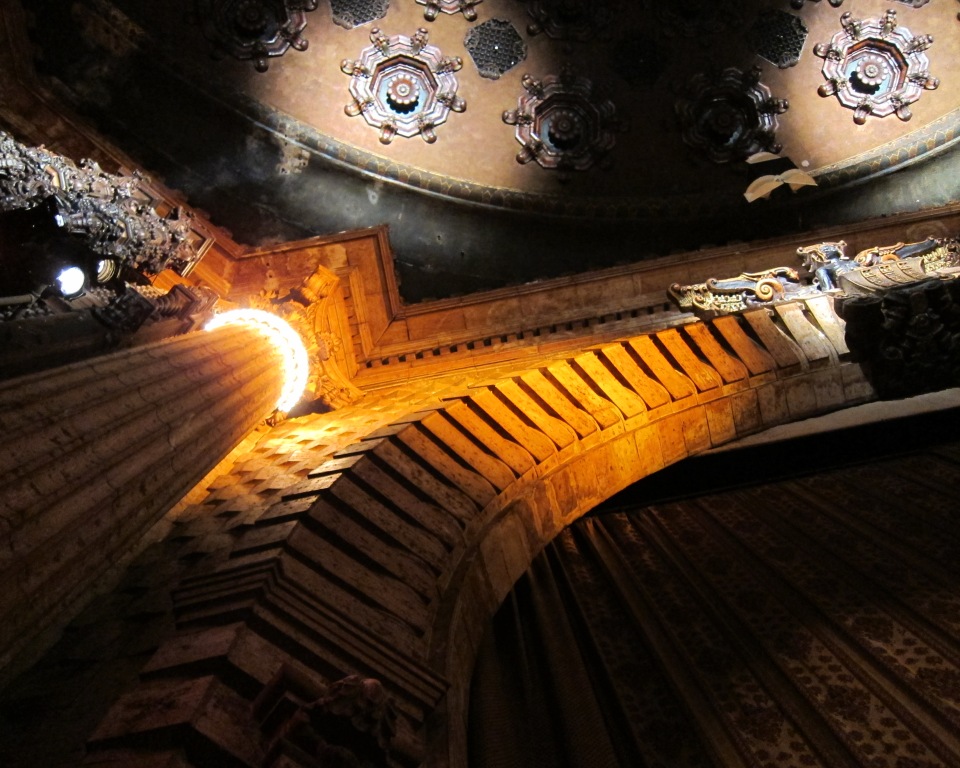
Standing at the edge of the stage, looking up at the proscenium arch and the coffered ceiling.

The auditorium's coffered ceiling was painted in brilliant colors with silver and gold, and the lighting scheme was the latest technology:
by means of great scintillators so placed as to throw streams of light on the gold and silver surface of the central dome, the entire house will be made radiant without the use of a glove in the ceiling. Theses scintillators will cast broad rays of light in colors, alternating blue, white, red and softer shades in the bright inner cone and the dull-toned rosettes of the dome.
On the exterior, Sid Grauman used searchlights to play on the architectural features of the building. It inspired excitement and drew crowds and made an impression even on those who didn't attend the show.

Sid Grauman and his New York rival, Samuel "Roxy" Rothafel, pioneered the idea of creating a theatrical spectacle to enhance the showing of a silent film. He devised the Prologue, a program that introduced the feature film with song, music, slide shows and spectacle related to the theme of the film.

An advertisement describing the program at Grauman's

The production was supported by a live orchestra of some 20 - 30 musicians, live singers and dancers, slide shows, and corps of costumed usherettes.

A typical program at what was then called Grauman's Third Street Theatre looked like this one from November 15, 1919:
  • Overture - "Oberon"
  • Current Events - special number compiled from all releases
  • Strips - San Pedro, California, Dustin Farnum wins motor boat race; Oakland, California, Wild Teal Flock above the Bay City; New York, Roosevelt Memorial Appeal, New York; in the City of Wonderful Nights, Washington D.C.; War Department reviews heros.
  • Vocal - "The Last Rose of Summer" Solo by Lucy Merz, soprano
  • Organ Solo - "Melody in F" A demonstration of how one theme can be used to play for an entire photoplay encore is being featured
  • Special - Miss Carolina Sunshine with hand lettered black and white slides projecting words of the song. Stage setting interior of a blacksmith shop with vocal duo accompanied by the orchestra and electric hammers on anvils. Encore number "The Vamp."
  • Scene - "Midst Peaceful Scenes" - Post Paramount
  • Comedy - "Up in Ali's Place" - Mack Sennett
  • Feature - "Luck in Pawn" - Dorothy Gish
  • Next Week - "Crooked Straight"
  • Note - Usual Grauman business on Sunday opening with long waiting lines. Special spectacle will be staged next week in which thirty Grauman usherettes will take part.
1918 view, Los Angeles Public Library, showing full stage with stage set and orchestra

Actor Laurence Tibbet got his first job singing in the Prologue at the Million Dollar Theatre. In this autobiography, he wrote that he sang dressed as a blacksmith, hitting a prop anvil with a prop hammer, and singing about shoeing horses. He was paid $50 a week. He writes that the theatre was "equipped with the latest gimcracks" including a huge orchestra platform that arose on an elevator.

The theatre was equipped with a first rate Wurlizter organ, and when people came in, the organ would be playing. One organist, Gaylord Carter, in a later oral history, related the instruction give to him by the theatre manager was to "perfume the air with music."

Sid Grauman also coordinated co-marketing campaigns. The Owl Drug Store, which occupied one of the retail spaces in the building, would concoct a soda-fountain treat to tie in with the feature at the theatre - like the Frederick sundae named after actress Pauline Frederick.

Detail from street view, 1920's, USC Digital Archive. Click to "embiggen"

Grauman had the advantage of being located in Los Angeles, so he could easily invite the Hollywood stars to attend his premieres and amplify the spectacle. Audiences would thrill at the chance to see a Charlie Chaplin alight from his limousine and stride a red carpet into the theatre - and have a chance to see the film with Charlie Chaplin actually sitting a few rows away!

With the success of the theatre at Third Street, Grauman went on the built the Rialto, further down Broadway, then the magnificent Metropolitan on Hill Street. In 1922 he made plans for a theatre further west in Hollywood - designed in the Egyptian style popularized by the recent discovery of King Tutankhamen's tomb. In 1926 another Hollywood theatre followed, this one designed in the Chinese style.

Grauman was an imaginative man, a gambler and a great practical joker. Perhaps this creative streak led him to see an opportunity in what might have been a forgotten accident during construction - while at the construction site, Grauman claims he stepped into soft concrete in the courtyard. It gave him an idea. Hollywood legend is a little more glamorous - star Norma Talmadge is said to have taken the first misstep, starting the tradition. At the theatre's opening, Mary Pickford and Douglas Fairbanks made their footprints and autographs.

Sid Grauman

Grauman and Rothafel sold the public the idea that a ticket bought more than the chance to see a strip of celluloid run through a projector. It bought an entire experience - spectacle, music, color, the comfort of the latest in climate control, and the thrill of being served by uniformed attendants.

Truth be told, the film itself may have been the least interesting element. Grauman himself, in an essay published in 1922, says:
The world of motion pictures is silent as the craters on the moon and colorless as pencil drawings on white paper. The element of color is absent; and perhaps permanently absent from picture presentation; but the element of sound can be controlled by music. Music wakes into life the silences of the picture plot; it covers up the weaknesses – or better still it converts those silences into and eloquence beyond the power of words to attempt
In Chicago, theatre owners Balaban & Katz tried the same ideas, and described their philosophy so:
We cannot afford to build up a patronage depending entirely on the drawing power of our feature films as we display them. We must build in the minds of our audience that we represent an institution taking a vital part in the formation of the character of the community.
Yet another theatrical mogul, Marcus Loew famously said, "We sell tickets to theatres, not tickets to movies."

Grauman's success paved the way for a younger Los Angeles man, theatrical architect S. Charles Lee, who would go on to design the Tower Theatre and the Los Angeles Theatre - the 1931 Los Angeles being the last of Broadway's movie palaces.

Lee's unofficial motto was "The Show Starts on the Sidewalk."

Sid must have loved it. He certainly lived it.

Wednesday, December 8, 2010

Million dollar man

Click to "embiggen" all photos in this post

Who's this fierce fellow, hanging out high above the stage of the Million Dollar Theatre for almost 100 years?

This weekend, the Los Angeles Conservancy presented its annual holiday matinee movie, "Scrooge!" - a musical version of Dickens's "A Christmas Carol" - at the Million Dollar Theatre on Broadway in downtown Los Angeles.

I'd been inside the building once before, on a Conservancy Tour in 2007. But chances to see inside the splendid movie palaces that still line Broadway are rare, so on the spur of the moment, I headed downtown with my new camera, to get a rare look inside this historic building.

The theatre was built in 1918 by a young up-and-coming theatre man, Sid Grauman. He and his dad had gotten their start in the entertainment business in Dawson City, Alaska during the gold rush years - they had gone bust as far as gold was concerned, but promoting boxing matches and other acts for the prospectors had been a winning business. They moved to San Francisco and bought a vaudeville theatre they outfitted for showing the new-fangled moving pictures. It was destroyed in the 1906 earthquake.

In Los Angeles in 1918, Sid teamed up with Adolph Zukor, a former fur merchant who now worked with Paramount, to build a theatre in a new office building going up on the corner of 3rd Street and South Broadway.


Sid had ideas about the new motion picture business, and the theatres built to show them. Early motion picture theatres were small facilities - converted storefronts or old remodeled opera houses. Only one new theatre - Clune's Theatre a few blocks south on Broadway - had been built specifically for the purpose of showing moving pictures, back in 1910.

But Sid Grauman was ambitious. He wanted something special. He wanted the best theatre in town. He had ideas about the kind of experience audiences would pay for. He wanted to create an environment where escaping into a fictional, fantasy world was enhanced and all-encompassing. He wanted the best theatre in town.

When the new Grauman's Theatre opened, it amazed everyone in town. The building's exterior, designed by Albert C. Martin in the Spanish Colonial style, with decor by Jose Moro, in elaborate Churrigueresque detail, with statuary evoking both mythological figures, symbols of the arts, and American details, like the heads of bison and Texas longhorn cattle.

At about 2300 seats, it was bigger than the houses over on Main Street, Los Angeles' established theatre district. It was bigger than Clune's Theatre, further south on Broadway, which had been built in 1910 for showing moving pictures. It had an evaporative cooling system. It had something called a Hansen seating device, which used sensors in each seat to indicate by a lighted panel for ushers which seats were available. It had a pipe organ that rose up from the orchestra pit, and a projection booth located at the front of the balcony, so that the picture would be bright and there would be no keystone effect.

Auditorium designer William Lee Woollett drew audiences into the fantasy as soon as they entered the lobby, with its huge domed ceiling and fantastic wall murals, one illustrating the Ruskin fairy tale, others with scenes from Shakespeare, the Bible and mythology. Inside the auditorium, a massive stone arch framed the proscenium, flanked on either side by soaring Greek columns, and organ screens that were over-the-top in their Churrigueresque excess.

Movies and vaudeville had existed together in the same venue previously, but Sid Grauman pioneered the idea of a coordinated program, called a "Prologue"with live entertainment enhancing the theme of the show on the screen. Shows regularly sold out, sometimes with lines outside the ticket window that stretched down the block.

The line this weekend for "Scrooge!" stretched around the corner of Third Street, where the windows of the Botanica displayed statues of saints and deities. The doors opened a good 45 minutes before curtain, so that theatre fans could wander the auditorium, lobby and mezzanine and take photos, chat, or enjoy treats from the refreshment stand.

In the 1945, the Million Dollar was taken over by Metropolitan Theatre Corporation and staged live presented musical acts such as Nat King Cole, Lionel Hampton, Jimmie Lunceford and other big bands. Then in 1950, it was managed by Frank Fouce, a Spanish language entertainment promoter, who booked Mexican and Latin American live artists such as Dolores de Rio, Maria Felix, and Celia Cruz. He alternately showed Spanish language films, often premiering major Mexican films. The Million Dollar Theatre became the best known Spanish cinema in the region.

It was during the '60s that the lobby was remodeled with a drop ceiling and a simplified foyer. The dome and the painted concrete walls were covered.

In 1993 Metropolitan closed the theatre, and leased it to a church. The church removed the name "Million Dollar" from the marquee - I guess the evocation of money was considered unseemly. The muraled auditorium walls were painted over with white paint, and nude statuary was draped for modesty's sake.

In 1998, the church moved out and the theatre was closed, serving only on occasion as a film location.

The current lease-holder, Robert Voskanian, began a restoration in 2007, and re-opened the theatre in 2008 with live performances, films, and presentations. He is working with the Los Angeles Conservancy and the Los Angeles Historic Theatre Foundation to help revitalize the area as part of the Bringing Back Broadway initiative.

Want to learn more about Sid Grauman and his Million Dollar Theatre? Stay tuned for more....