Sunday, December 23, 2012

Thematic Photographic - Industrial disease

Carmi at the blog "Written, Inc." posts a photographic challenge each week at Thematic Photographic. This week, the theme is "Industrial disease."

What is industrial disease? And what's your take on it? Share it at "Written, Inc."
Click to "embiggen"
 We were walking from our hotel on Cambridge Heath Road in Bethnal Green toward the Broadway Market in Hackney, and as we walked through the neighborhood that ranged from council apartments to older townhouses and industrial warehouses, we came upon the sight of two huge circular iron structures.

Our first sight of the structures
Just beside the Regents Canal, they loom over the filthy water, the industrial landscape, and the shabby old barges. What are they, I wondered. The ironwork is functional yet surprisingly decorative, a tracery of iron against the sky. They looked very 19th century, and very "steampunk."

From the Broadway Market
 After our market visit, we walked back alongside the Canal, and asked a dog-walker passing by whether he could tell us what these things were. "They're gas-holders," he said. In the old days, these structures held giant membranes that stored fuel gas.

Near the First Avenue Bridge, 1920s LA Public Library photo
I remembered seeing similar structures in historic photos of Los Angeles and wondering what they were. So I did some quick research.

The gasholders here in Bethnal Green were built by the Imperial Gas Company in around 1856. Also called "gasometers," the structures that remain today are an external frame for telescoping storage tanks for fuel gas. The tank's base is in a reservoir of water, which creates the seal to keep the gas from escaping. When more gas is pumped into the tank,  it expands; when demand from users depletes the gas, the tank collapses. This assures that the gas is always maintained at the correct pressure.


Far from being diseased, the ironwork is quite beautiful if you look closely. As with the ironwork arcades of Paris, the cast-iron buildings of New York's SoHo, and the great railroad stations of the 19th century, the makers of these structures did not omit beauty from their designs, despite the industrial and commercial purpose.

Seen at night, from the Hackney Road
Technological changes in the way gas was processed and distributed made these tanks obsolete. There are still several abandoned gasometers in Britain and Europe, although the ones in Los Angeles are long gone. In Bethnal Green, where an increasing infusion of artists have moved to the neighborhood, the delicate tracery and cylindrical shapes seem to transcend their industrial origin and lend an eerie sculptural beauty to the urban landscape.

Saturday, December 22, 2012

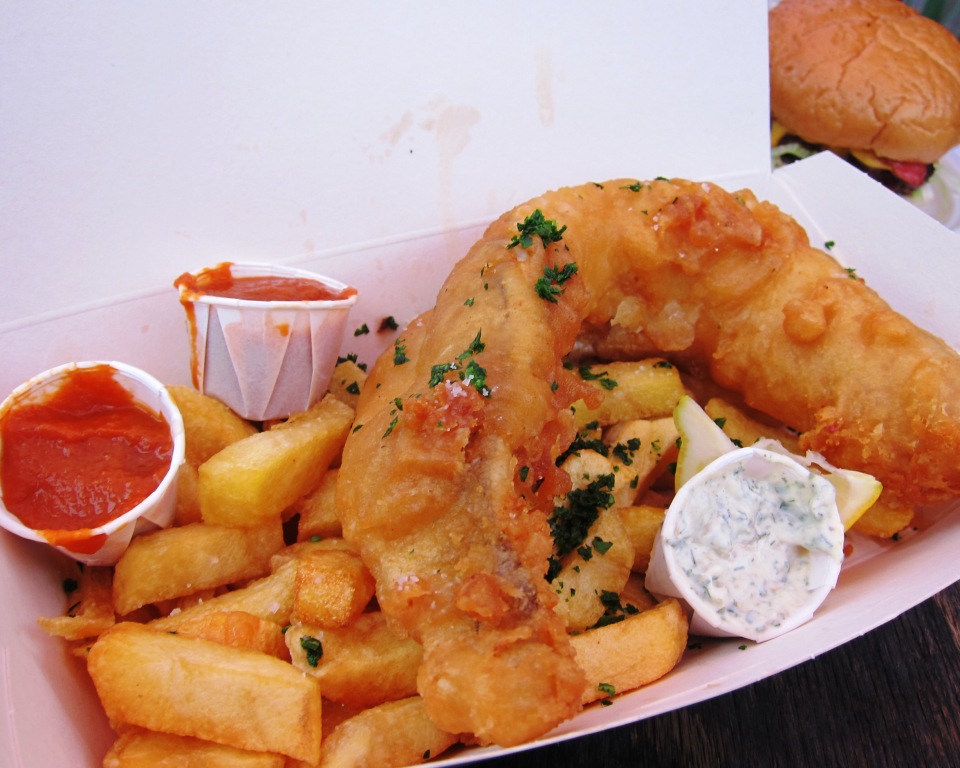
Local chip shop, Hackney style

Perfect fish and chips, homemade tartar sauce and tomato sauce

The local fish-and-chip shop - or chippie - is a fixture of British neighborhoods. I've walked past hundreds, looking all the same, fluorescent-lit, smelling of stale frying oil and not so fresh fish, and not been tempted.

But fish and chips is extremely popular, and our son promised that we'd enjoy his latest gastronomic discovery.

The Broadway Market takes place on Saturday in Hackney near the Regents Canal. And even though it was pouring down rain, the market was thriving. We strolled the length of Broadway, marveling at the food and goods for sale, and then our son veered off on a side street, walking past the London Fields Primary School and toward the railway overpass.


He turned into a gate, and we found ourselves in a fenced, smallish yard full of more stalls and vendors. The Netil Market is a wee off-shoot of the Broadway Market, started to provide opportunities for local designers and craftspeople.


It was a little bit of a shambles, even more so in the rain. Shaky tarpaulin-covered frames sheltered tables of cluttered merchandise, and small wooden shacks housed more permanent vendors. One vendor sold shakes from a VW bus.


The Fin & Flounder fish and chip stand was between a florist and a burger stand. The cheerful young man behind the counter fried our lunch to order, putting fresh fillets of haddock into the batter, then dipping them carefully into the fryer basket, all the while keeping up a steady conversation.

We carried our fish and chips over to the cluster of mis-matched tables and chairs arranged beneath sagging tarps, taking care to dry off the seats before sitting down. It was cold and wet, and every once in a while a pool of water would overflow the edge of the tarps, bringing down a stream.

Cheerful snowflake decorations in the eating area
Even so, the battered fish was golden and piping hot, and the perfect crispness gave way to creamy pure white flesh beneath. A squeeze of lemon and a dunk into the home-made tartar sauce made it even better.


I could hardly believe I was eating something so perfectly delicious while shivering with cold feet on rain-puddled asphalt, but it was one of the best meals I've ever had.


[The Man I Love] enjoyed his, too, and I think he managed to stay dryer than I did!

Now can we go find a pub?

A Christmas panto

One British holiday tradition we Americans are unfamiliar with is the Christmas panto. Panto - or pantomime - is a popular theatre presentation that includes singing, dancing, slapstick, audience participation, and buffoonery.


We went to see the panto "Dick Whittington and His Cat" at the Hackney Empire Theatre. The theatre, which was built in 1901, is a stunningly restored classic music hall, and I couldn't stop marveling at its beauty. With its multiple curved balconies and opera boxes, it seats 1000 people in a space that's both intimate and majestic.

Theatre lobby
Pantos also have a long tradition of including transvestism as a convention of the performance. The young male hero is played by an actress, in what is known as a "breeches role."  Another stock character is an older female, played by a male actor in drag. Nowadays, many Christmas pantos take this convention to its logical extension and the productions have become gay-themed drag shows, but "Dick Whittington and His Cat" played it relatively straight.

Balcony and stalls
Pantos are family entertainment, despite the saucy innuendo, and the audience was full of children. A crusty old vendor outside sold flashing LED novelties like bunny ears and magic wands.


Audience participation is a big part of the tradition, and the performers kept the audience engaged, calling for responses, encouraging cat-calls and shout-outs to "look out behind you!" or "wake up!" We were pulled to our feet for sing-alongs, and encouraged to boo the villains loudly.

The beautiful painted ceiling
Though conventional, with a few simple special effects, the production showed a relatively lavish budget. The scenery was old fashioned painted drops, wings and borders. A full stage scene was followed by an 'in one" transition scene while the sets changed behind a scrim. Even so, each scene was nicely done and imaginative. There was a scene set on board a ship; a scene under the ocean; a scene on a jungle island. Steve Elias, as the star of the show in drag, had an elaborate new costume in every scene, complete with flamboyant hats and props.

Publicity photo of Steve Elias, the star of the show
Pantos tell traditional stories, but update them with contemporary details from popular culture. The Fairy Bowbells, striving to earn her fairy wings for a good deed, was a plump little Bollywood cutie, flying in on visible wires from the wings. The King Rat sported rasta-style dreadlocks, and the ingenue rocked it like Mariah Carey. We were treated to "gangnam-style" dance numbers, and in the jungle scene a giant costumed gorilla danced to the reggae tune "Monkey Man."  There were political jokes that went right over our American heads, but it was clear that the rest of the audience got them. The give-and-take was localized, with references to the Hackney audience and disparaging comments about rival neighborhoods.


The plot was simple and, as the evening progressed, mattered little in comparison with the gags and the visuals. The show lasted for two hours and forty-five minutes - and, surprising me, the audience of young children remained engaged. We got just as involved, heartily booing and cheering with the rest of them!

What a fun tradition for the holidays. Would it go over in America?

Friday, December 21, 2012

A rare pearl

The Hackney Pearl
 Like a lot of young people trying to find the path their lives will follow, our friend Alex has a job at a restaurant. The way she tells it, she walked into the place shortly after moving to the neighborhood, got a cup of coffee, and liked the place. When she found out they were hiring, she applied.

The Hackney Pearl is located in Hackney Wick, an East London neighborhood that is becoming a haven for artists and other alternative life-style folks looking for inexpensive digs. Owned by artist/chef James Morgan, it's a neighborhood joint where you can get a cup of tea and hang out - and it's also a place where Londoners in the know come for great food.

Sign of the day


Seen in the Tottenham Court Road tube station.

Thursday, December 20, 2012

Art critics


Today, we went to the Tate Britian, one of England's oldest and most venerable art galleries. Located along the Thames River in Milbank, it holds a permanent collection of British art from the year 1500 to the present day.

This season, there are two exhibits that are attracting crowds - one is an exhibition of Pre-Raphaelite art, and the other showing competitors for the Turner Prize.

Entrance to the Turner Prize exhibition

The Turner Prize features four young artists, and beginning in October, the chosen artists' work is displayed and then the winner of the prize is announced in December. Part of the exhibition included a bulletin board wall where viewers could post their comments on notes.

Click to "embiggen"
This was my favorite.

Everybody's a critic.

Bethnal Green on a rainy morning


The Salmon & Ball pub on the corner of Cambridge Heath Road and Roman Road. Photo taken during a morning foray for breakfast supplies. Click to 'embiggen"

Wednesday, December 19, 2012

Traveling and arriving


I really do love to travel. I love the mental shift that takes place when you leave behind your routine world. I love how, especially when you go overseas, you are plunged into a world that's strange to you, but normal to everyone else. I love the effort of adapting to the "new normal."

Although sometimes travel can be a challenge or even a real ordeal. Still, I love to give myself over to it. You never know what you're going to get when you start out.

Our Topanga life is so familiar. On Tuesday, I started the day with my routine dog-walk in my Topanga neighborhood - although it was a bit abbreviated because of rain. Then home for breakfast, shower, dress and then I took Jack to the Topanga Pet Resort, which will be his home while we're gone. It's like dropping a kid off at summer camp - they never look back!

We're here

We've arrived in London, at our hotel.

It's a fascinating, quirky hotel - a mixture of old and new, of artsy-funky and sleek.

Awaitng us when we arrived.
 We're exhausted, but after we've had some rest, I'll show you more.