Showing posts with label Fox River Valley. Show all posts

Saturday, May 27, 2017

Wildflower walk

Tradescantia ohiensis - spiderwort
Some sights from the Wildflower Sanctuary along the Riverwalk in Batavia, Illinois.

Trillium recurvatum - "Wake Robin" trillium

This volunteer-built sanctuary was begun in 1991, showcasing the native woodland plants growing along the Fox River in Northern Illinois.

Aquilegia canadensis - wild columbine
When I lived here as a child, I explored the woods, prairies, and creeksides of this landscape. My mother helped me identify flowers I found.

Anemone canadensis - meadow anemone

Wild iris
Walk through the cool shade to find small treasures.

Phlox divartica
Bright flashes of color in the green.

The Challenge Windmill Factory building
The walk follows the river, which powered mills and factories beginning in the 19th century.  The factories are built of limestone quarried nearby.


Batavia's factories built windmills, as intricately styled as flowers themselves. Some of these antique windmills are on display at the park.

Monday, July 11, 2016

Healing sights


Echinacea purpurea, the purple coneflower that is native to the American midwestern prairie states, is said to possess healing properties. Scientists and doctors have been unable to prove the claims, however.

But for me, just being here in Geneva, Illinois, walking through Island Park on the Fox River and seeing a bed of purple coneflowers in full bloom is healing enough.

Monday, July 4, 2016

The kindness of strangers


My next door neighbor, a young man who moved here from Cherry Hill, New Jersey, just came over and weed-whacked my tiny little back yard, where the grass had grown up past ankle- high.

He and his girlfriend are staying in a rental where her grandmother used to stay. They have a connection here. And a new puppy, now - I hope Jack will be able to play with it in the park soon.


When he cleared my lawn, I had to remove the pink flamingos. They've been reinstalled in the street planter box, where they'll gain more visibility.


My little container garden is thriving, despite the heat.

Friday, July 4, 2014

Thursday, July 3, 2014

Fireworks across the river

Click to "embiggen"
Not, apparently for the holiday - these fireworks are to celebrate a victorious athletic contest! Here in the Fox River Valley.

Thursday, October 3, 2013

Thematic Photographic - Multiples

Carmi at the blog "Written, Inc." posts a photographic challenge each week at Thematic Photographic. This week, the theme is "Multiples."

Rows of pickles
I really like to photograph arrays of things - so "multiples" is a good theme for me. Here are photos of multiple items arrayed at a Farmer's Market - the Sunday French Market in downtown Geneva, Illinois. What better place to see multiples than a market display of abundance!


Gourds and pumpkins for fall decorating.


Rows of vintage Nancy Drew books, at the used bookseller.


Bright and beautiful bell peppers in a rainbow of color.


More bottled beauty - salsas and relishes.

Tuesday, October 1, 2013

Pretty little town


Geneva house built of local limestone, dated 1855
Geneva, Illinois is a pretty little town.  Like its neighbor to the south, Batavia, and its neighbor to the north, St. Charles, it grew up on the banks of the Fox River, using the power of the flowing river to drive the engines of industry.

While Batavia made windmills and other agricultural machinery, Geneva in turn processed the products of agriculture. A creamery was one of the first industries; Geneva mills also processed flax, made sugar from corn, and milled grain for flour.

Monday, September 30, 2013

Wind flowers

Model "E" windmill, U.S. Wind Engine and Pump Co.

I lived in the little town of Batavia, Illinois, while I was in grade school. The oldest town in Kane County, Illinois, founded in 1833, Batavia is on the banks of the Fox River, and almost immediately after white people arrived, it became a manufacturing dynamo for America's westward expansion.

The Fox River provided water power for the flour mills that ground the wheat farmers grew in the rich Illinois soil. It also drove the saws and milling machinery that built farm equipment, provisioning the homesteaders and settlers what they needed to conquer and domesticate the vast prairies of the Midwest and central plains. It drove saw mills that sliced the downed oak, maple and hickory trees of the Big Woods, clearing the land for the farms and milling the lumber to build barns and farmhouses.

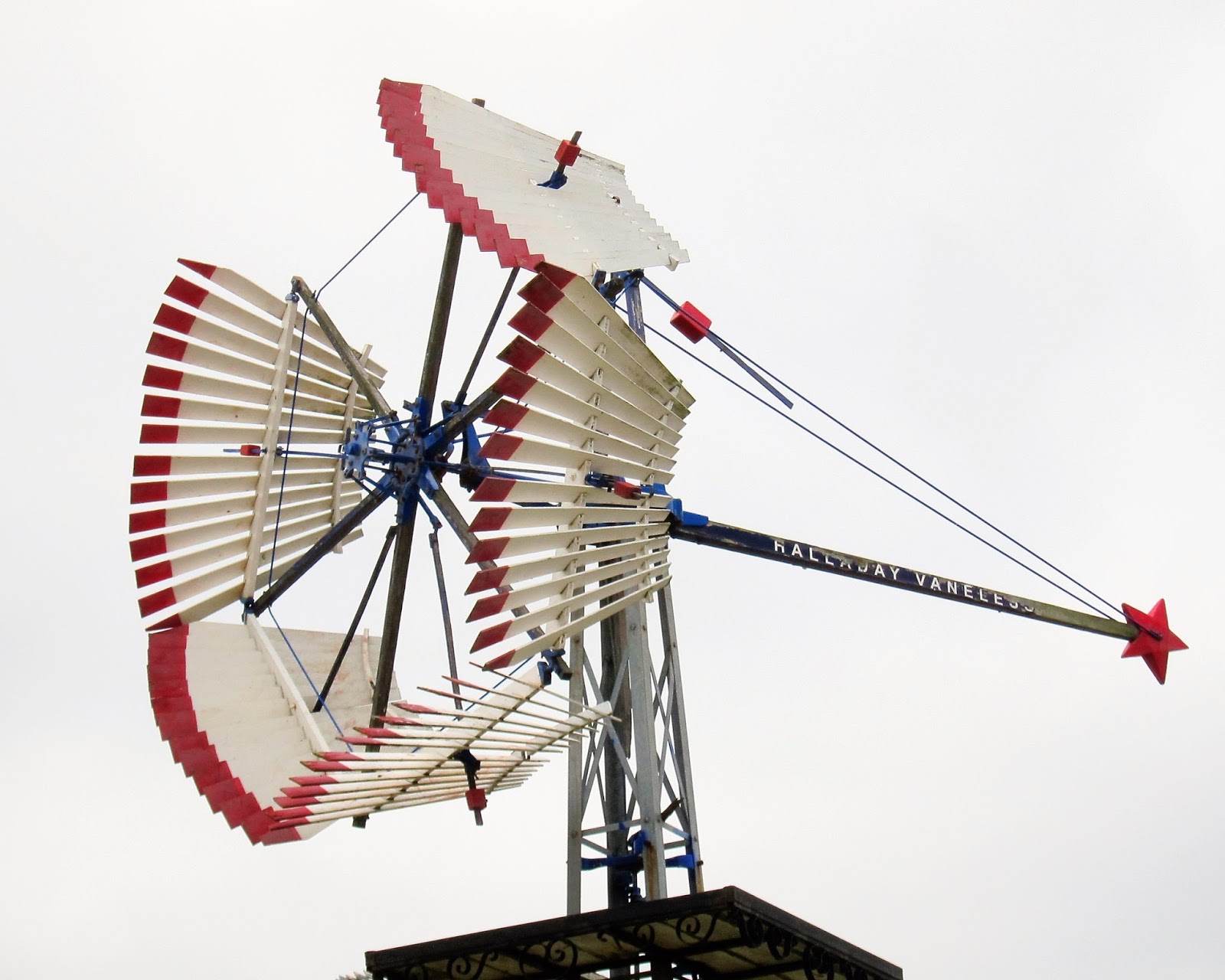
Halladay Vaneless windmill, manufactured by the U.S Wind Engine and Pump Co.
Batavia was home to three manufacturing firms that made windmills - essential machinery to draw valuable water for irrigation, using the endless energy of the wind that rushed across the high flat land. These factories ranged alongside the Fox River, built from the mellow yellow limestone that was quarried out of the river bluffs just north of the business district. There was the Appleton Manufacturing Company, the Challenge Company, and the U.S. Wind Engine and Pump Company.

Challenge vaneless windmill

Batavia now proudly calls itself the "Windmill City," reviving and celebrating its heritage, but back in the 1960s when I lived here, we didn't know anything about windmills. The crumbling yellow buildings by the river were run down, home to small factories and warehouses.

Goodhue Special windmill, manufactured by the Appleton Co.

Today, the old Appleton factory has become the City Council meeting chambers, and the area around the old factories have become parks that connect to the Fox River Trail. These vintage windmills are displayed in the park nearby.

Challenge vaneless windmill
Beautiful as the conventional windmills are, I was fascinated by the shapes and intricacies of the two antique vaneless windmills displayed here. A vaneless windmill has no tail or vane, and its wheel turns behind the tower instead of at the front. These examples have wooden wheels and cast iron counterweights that keep the wheel turned into the wind.  The balance between wind velocity and the counterweights regulate the speed of the mill, so the slats adjust to the force of the wind. Once the wheel reaches a maximum speed, it does not increase.

The limestone building used to be the Appleton factory.
On the light, breezy day I visited, these mills were braked, and could not spin in the wind. But how I would love to see their flowered, feathered shapes in full motion, spinning. What beautiful, fascinating wind-flowers to bloom on the high prairie!

Friday, September 27, 2013

Thematic Photographic - Large structures

Carmi at the blog "Written, Inc." posts a photographic challenge each week at Thematic Photographic. This week, the theme is "Large structures."


This railroad bridge looms over the Fox River in Geneva, Illinois. The massive scale of its concrete piers lends the structure a monumental majesty.

Built in 1917 for the Chicago and Northwestern line, today the bridge carries Metra commuter trains from the city of Chicago to the western suburbs. The early morning sun shines on the broad arches, reflecting in the still water as a morning train passes over.

Another view
The river bank is now a park, with running and biking trails, and a footbridge has been added to the base of the bridge. Today, this large structure, which has been here for so long, has become part of regular peoples' everyday lives.

Monday, August 1, 2011

Illinois wildflowers

Campanula americana, American bellflower
I lived in the Fox River Valley as a kid from the ages of seven to twelve. Our home in Batavia, Illinois, was in a new subdivision, and our house was surrounded by vacant lots that allowed me to safely explore wild habitats ranging from deep deciduous woods to prairie to swampy wetlands. With a little pocket wildflower guide, I learned to identify the flowers and trees around me.

On our recent trip to see family, I enjoyed walking the Fox River Trail - as its name implies, it follows the river, and links the parks and nature preserves of the small towns along the way. It was a treat to see again the wildflowers I remembered from childhood, and to find new ones to identify - or to puzzle on.

Queen Anne's Lace, or wild carrot, Daucus Carota
One of the most recognizable flowers is Queen Anne's Lace. This weedy but pretty plant is not an Illinois native, but was introduced to the United States from Europe.

Impatiens capensis
Another European import, Jewelweed, gets its common name because its leaves, when held underwater, appear silver, or "jeweled." Its botanical name is Impatiens capensis. I remember this plant from my childhood, but I don't remember its North American native cousin, Impatiens pallida, with pale yellow flowers.

Impatiens pallida
I found the two species growing together in the moist woodsy paths at the Fabyan Forest Preserve.

Purple loosestrife, Lythrium salicaria
 The moist and marshy edges of the river are a perfect habitat for another invasive weed, purple Loosestrife, or Lythrium salicaria.


An almost look-alike to loosestrife is Liatris - each has a spike of lavender-pink flowers, but there the resemblance ends. Loosestrife is native to the old world, and it's become a dangerously invasive weed, especially in waterways, crowding out native plants and even native animals like amphibians and insects. The much more benign Liatris spicata, or Purple Gayfeather, is a native prairie plant.

Some of the plants I saw on my riverside walks I was unable to identify.


This is obviously a wild onion of some kind, with its gracefully drooping umbrels of flowers, but which one?


Is this catchfly, or Silene carolinana?

Click to "embiggen"
And this one was a real puzzle for me. Very tall, up to six feet, with huge palmate leaves. Sprays of small white flowers. It grew in the deep shade near the railroad trestle. I couldn't identify it in any of the online data bases - not at all. Does someone want to give it a try?

Saturday, July 30, 2011

Pink Saturday - flowers for the heat

 Pink Saturday - Beverly at the blog "How Sweet the Sound" hosts Pink Saturday. Let the color pink inspire you!

I admit it, I'm a weather wimp. Although I grew up in the steamy Midwest, I've been spoiled, living more than 18 years in Seattle, where it's temperate and pleasantly moist, and in Los Angeles, where it's temperate and dry - and when it's hot, it's a dry heat.

Here in Northern Illinois, we're re-encountering that feeling when you walk outside an airconditioned space and hit a wall of hot pea-soup heat.

July has brought 100+ degree temperatures and thunderstorms to this part of the country. The moisture in the air, though, keeps the plants hydrated and keeps the landscape green. Heat-loving flowers are thriving - like these bright pink zinnia, growing in flower beds at Geneva's Island Park.

Thursday, July 28, 2011

A rainy morning

 
I went out this morning hoping to beat the heat for my daily walk. It had been raining most of the night, with thunderstorms, but by morning the rain let up enough for me to go out. I crossed the Fox River on State Street, and then took a flight of stairs down to Island Park, on the East side of the river.

Saturday, May 21, 2011

Pink Saturday - "The End of the World"

Pink Saturday - Beverly at the blog "How Sweet the Sound" hosts Pink Saturday. Let the color pink inspire you!


So according to some, the world is going to end on May 21, this Saturday. I don't believe in that stuff, so the first thing the phrase "The End of the World" brought to my mind was a musical memory - and a pink memory.

It's summer, 1965.  I'm sitting on the living room floor of my friend Mary's house, listening to her sixteen-year-old sister Annette playing 45 rpm singles on her Hi-Fi.  I'm sleeping over, and Annette is helping us set our hair with pink, snap-on plastic curlers.  We'd slather our hair with Dippity-Do, roll it up and snap on the pink plastic clamps. We twined spit-curls against our cheeks, then held them fast with Scotch tape.

Wednesday, February 18, 2009

First words

In my family, the story goes that my first words were "Booful flowers." Beautiful flowers.

According to the story, I spoke them in the front yard of my family's first house in Pennsylvania. I'm sure it was the petunias that caught my eye.

I liked to play in the yard, and my parents let me play as much as I liked without worrying about getting my rooster-print sundress muddy. It made me pretty confident, and comfortable with bugs, dirt, worms, water, and leafy things.


I remember the first time I learned a flower's name. We lived in a suburban small town west of Philadelphia. Behind our house there was a small patch of woods that I was allowed to venture a few steps into.

There were evergreen shrubs with pretty, intricate pink clusters of flowers, and my mother taught me their name - Mountain Laurel.

Kalmia latifolia photo by Alan S. Heilman, University Tennessee Herbarium, from US Forest Service

When we moved to Illinois, our house was one of a half dozen or so built in a newly planned subdivision built on farmland in the Fox River Valley. Our house was surrounded by woods and fields. I was given a small field guide to wildflowers, and looked for flowers like Wake-Robin Trilliums, Mayapples, and Jack-in-the-Pulpit.


Each spring the floor of the woods was carpeted with clusters of Spring Beauty, or Claytonia virginica.


My mother grew hybrid tea roses - the ones I remember well are Peace, Tropicana, Queen Elizabeth, and Sterling Silver. One summer she used a mulch of cocoa-bean hulls - I can still remember the smell of hot chocolate in the sun. She also grew annuals like snapdragons, sweet alyssum, and pinks.

I am not sure how old I was when I started looking at the Wayside Gardens catalog my mother got in the mail. They were large, expensive-looking volumes, carefully bound, with colored photos and elaborate descriptions. I still remember plants that fascinated me - Corylus contorta, or "Harry Lauder's Walking Stick" hazel - Butterfly bushes and Franklinia trees. These plants are still offered in Wayside's catalog today.

Wayside printed the plants' common names alongside their botanical names. After a time, the botanical names were just as easy for me to remember as the common names.

I've noticed that I have acquired a peculiar talent. I always name the plants I see. Wherever I am, if I see a plant, some part of my brain marks its name. This quirk is always just teetering on the edge between consciousness and subconsciousness; I can be walking down the street with a friend, having a conversation, and as we pass the planter-boxes of the Wells Fargo Bank or the hedge-rimmed library, a little voice in my brain is rattling away, "Buxus sempervirens, agave, that purple lantana you see everywhere, rose - is it "Iceberg?" - a nice dwarf nandina, that variegated daphne, ipomoea, anigozanthus - and oh what a pretty daylily!"

Name the flowers. I've done it since I learned to talk.

Is that weird? Does anyone else do this, too?

Sunday, November 23, 2008

Swedish rescue

When we moved Mom into her new place, the management allowed me to spend the first two nights with her, making sure she was settled and didn't have trouble finding her way around the place. But no matter how much you love someone, spending a lot of time together in a small space can be exhausting.

On the second day, my brother came to the rescue. He suggested we let Mom go to the dining room herself and get acquainted with her new neighbors, while we went out to lunch. He brought me to Stockholm's, a little brew pub on State Street in downtown Geneva, Illinois.

The place was dark, old-fashioned, with a great old 1930's style back bar. Swedish and Danish flags were proudly displayed - reminding me of Geneva's Scandinavian heritage. Each summer, Geneva has a big street festival called Swedish Days. When we lived in this area, back when I was in grade school, Geneva was the town we'd come to on Saturdays, to see matinee movies at the small cinema, and where Mom would take me shopping for school clothes, at the Merra-Lee Shop. The cinema is now a restaurant, but Merra-Lee is still there.

Geneva is the county seat of Kane County, and Stockholm's is only a couple blocks from the courthouse. The lunch crowd looked like lawyers and local business people. The TV was on low, and the atmosphere was quiet, dark and restful.

They brew their own beer and ale at Stockholm's. We ordered a couple of pints of light golden ale called Aegir's ale, and some sandwiches.

I looked around. It seemed timeless. At the bar, the stools each had little brass nameplates on the back, for the "regulars."

Local barrooms aren't generally featured in the memories of schoolchildren, so I don't know whether Stockholm's was there when I was little, or if it was a new place crafted to look old. The wall painting of a Viking ship under full sail tugged a little at my memory banks - was it familiar? Had I seen it as a child, perhaps, from the sidewalk, or from a passing car?


No matter. We sipped our pints, and shared my french fries. Stockholm's was a fine place to spend a cold November afternoon, and catch up with one of the nicest people I know - my brother.