Showing posts with label Hosed. Show all posts

Monday, September 5, 2011

Too much of a good thing

Olive oil and water
You'll see Escolar listed on menus in fine restaurants. It's sometimes described as butterfish, because the flesh of escolar is known to be succulent and "buttery" tasting.

I recently ordered escolar at a fine Santa Monica seafood restaurant. I was presented with a 2" thick filet that was perfectly cooked and -living up to its reputation - deliciously flavored.

I have a small appetite, and couldn't finish my serving, so I are maybe half and brought some home and ended up serving it to Jack.

The following morning, I noticed something weird.

OK - you've all followed me through my ordeal with my colonectomy. You've all stayed with me through my preparations for surgery, my colonoscopy, all the discussions of the internal workings of the human digestive system. So, here we go again with something gross.

When I went to the bathroom, there was an oily, orange discharge in the toilet.

I was worried. Did my surgery take out some crucial portion of my lower intestine that digests oil? Have I failed to re-generate critical bacteria I need in my digestive system? What is up?

I also wondered what I ate that could have caused it. On Friday, a friend had bought me lunch at a local Mexican restaurant famed for its giant sauce-covered burritos. Maybe the cheese and carnitas had been too much for my system? Or was it the nachos that [The Man I Love] made from some chips we'd taken away from a place in Inglewood. Were they fried in Olestra, maybe?

So finally, I decided to google-research. I never even dreamed that the perfectly fresh, perfectly prepared fish filet would have caused this, so I googled a lot of other words, but in only a matter of moments, I saw that rising to the top of the search hierarchy were articles about how eating escolar causes digestive problems.

Escolar - though delicious - has been banned for consumption in Japan since 1977. The fish itself,  epidocybium flavobrunneum, cannot digest certain fats in its own diet, so it retains them in its body. We humans can't digest them, either, so when we eat escolar, which has an oil content of 14 - 25%, we have problems.

People who eat escolar sometimes experience diarrhea, stomach cramps, vomiting, and - worst of all - anal leakage. Me, I just had drops of orange colored oil appear in my toilet bowl. Apparently, it doesn't hurt you - it's just temporary. Maybe for some folks, it's worth it for the deliciousness of the fish. But I'm not sure. As a person who's experienced gastro-intestinal problems, it was pretty scarey even though it didn't make me feel bad.

I'm fine now, after a couple of days, and don't feel bad at all. But I wrote to the restaurant and let them know what I learned. I'll let you know how they respond.

UPDATE at 8:54 pm - Boy that was quick. The restaurant responded almost immediately, said they were suspending service of escolar while they researched it, and will keep me informed. Good for them!

Monday, August 22, 2011

Smile for the camera!

Health is serious business for everyone, and so after my experience with complicated diverticulitis and colon surgery this spring, I took my referral for a colonoscopy seriously.

The procedure was today. I spent yesterday preparing for the procedure, which, if you've had one, you already know isn't pleasant.

I last had a colonoscopy - my first - about six years ago. It was routine. I remember Our Son was the one who drove me there, waited in the waiting room and took me home. I remember being SO HUNGRY during the fasting part of it, and dreaming of where I'd ask him to drive me immediately after leaving the hospital, so I could eat. But actually, that time I was really really out of it. I don't remember a lot about the procedure or the aftermath. And when it was all over all I wanted to do was go home, not go eat.

This time, I barely knew that I was put under, although I must have been because they were halfway through the procedure before I realized it was taking place. It was at that point I put my glasses on and watched the monitor - something I hadn't done the first time. My doctor kindly showed me the site of my surgery, telling me it looked perfectly fine. Then I watched the little camera navigate the pink, corrugated tubes of my innards. You can see examples of what it looks like HERE.

Then it was over.

This time around, I was surprised. I felt pretty good. I felt awake. I felt HUNGRY. I asked [The Man I Love] to take me to El Cholo in Santa Monica, just a few blocks away from the hosptial.


Mmmm. Chile rellenos!

I have a clean bill of health. Everything's good. It didn't hurt, and it was only mildly inconveniencing. If you're due for one, and putting it off because you're nervous or worried - don't. Do what you need to do. Take care of yourselves, everyone.

Friday, June 10, 2011

Checking in

Today saw my doctor for a post-operative exam. He says I'm doing great! I'll need to schedule a colonoscopy in the next couple of months, just to be sure, but he thinks I'm going to be just fine!

Here's some sweet summer lavender, in bloom in the garden.

Monday, May 30, 2011

Comfort to strangers

A young man hiccups in the hallway. He must be twenty, twenty two perhaps. He sounds like any young dude, a little high or drunk, maybe. At first, he is so mild-mannered and casual I think he is a visitor or a hospital worker. He hiccups again.

He can't stop hiccuping. The nurse asks questions one after the other in her pert, accented voice, chirping almost merrily, "Can you take a deep breath for me? Do you smoke? How many packs a day? Does it hurt here? Where you from?" He talks of Hinsdale, Illinois - it's not clear what the connection is. Then suddenly he retches, painfully; gasps, and sobs.

With that, I know he's a patient.

"You okay?" asks the nurse. It is a rhetorical question, but he answers honestly, his voice breaking, "No. No, I'm not okay...." and his voice breaks. "I don't know where I am, am I in L.A?"

He retches again. "I'm just so tired of throwing up," he says, sobbing. "Will you hug me?"

The nurse laughs - and though she laughs it is nevertheless a laugh that holds great tenderness. "No, we can't hug you, but we'll take care of you. Here is your pillow, you hug your pillow."

Day nurse

He strides into the room in the morning, a manila envelope in his hand. He pulls out his notes and checks them. He says my name, checking the notes, then puts out his hand to shake, introducing himself. "I'm S. I'll be your RN today."

Tall, lean, grey-haired, blue-eyed, handsome.  He asks if I need anything. He checks the IV, the epidural. He checks the wristband.

Sunday, May 29, 2011

Off leash, still in the doghouse

I arrived at the hospital on Wednesday. On Wednesday night when I came to this pleasant room, I had three tubes attached to me - an IV for fluids and nutrients, an epidural line in my spine for pain management, and a Foley catheter to my bladder.

By Thursday night, I could drink clear fluids. Encouraged to walk the halls, I wheeled my dancing partner - my IV stand - along with me. I successfully met  the goals and objectives that were set for me - to fart and poop.

By Friday, I could eat solids and my IV was removed, but the epidural remained, plugged into the wall when in use and beeping "battery low" warnings as I wandered the halls.

This morning the epidural went away. All that remained was the Foley - a white vinyl bag about the size of a spring-time purse, that I dangled  from my wrist while walking up and down the linoleum halls. Then, it too went away.

Now I sit in my hospital room - off the leash. I'm wearing clean pajamas I brought from home. When the epidural went away, so did any pain medication. I'm slowly becoming aware of my incision, a tender, crimped feeling below. I think the plan is to give me oral pain medication eventually - but so far I haven't seen it.

Will I go home, or spend another night here? No one knows anything yet.

Meanwhile, I sit here, in the ward that is sometimes quiet, sometimes lazy, and other times bustling with action and characters. From behind my curtain, I observe some of these characters. I sometimes get to peek out at them, or sometimes, they peek in at me.

The Master of the Universe

The Master of the Universe is not pleased.

He was promised a shower immediately when they sent him upstairs, but the nurses insisted on doing something with the meds and things, and next thing you know it's eight o'clock and they're telling him he can't take a shower till morning. What, is there like some doctor's orders saying no showers?

The doctor promised when the Master of the Universe talked to him downstairs - but the doctor is gone now - just like him to take off without assuring that all arrangements for the Master of the Universe were firmly in place. Typical. "Well, yeah, it's UCLA but it's the one in Santa Monica. No, in Santa Monica. On Wilshire."

He can't see how they put the gown on him, and the way these tubes run through it here, no wonder the Master of the Universe knocked over the water pitcher. If the nurses had been quicker at getting the floor cleaned when he asked, he woulda been able to keep his socks dry, but now he needs a new pair - "I mean now, not later!" - of course if he could just take his shower everything would work out.


Saturday, May 28, 2011

Hell Hospital

Click to "embiggen"
It's two in the morning. I suddenly awake in the dark to a child screaming.

A full-throated moan it rises unbearably. Fear and panic ring as the voice cracks as it reaches its height..

The sound is on the other side of the wall at night in the hospital.

Friday, May 27, 2011

Fart Proudly!

In the 1780s, American diplomat, scholar, inventor, and all-around smart guy Benjamin Franklin wrote to the Royal Academy of Brusselles. They conducted an annual prize competition for scholarly innovation, and he had an idea for a competition. It is included in a slim book of Franklin's essays titled "Fart Proudly!":
"It is universally well known, That in digesting our common food, there is created or produced in the Bowels of human Creatures, a great Quantity of Wind.

That the permitting this Air to escape and mix with the Atmosphere, is usually offensive to the Company, from the fetid smell that accompanies it.

That all well-bred People, therefore, to avoid giving such Offense, forcibly restrain the Efforts of Nature to discharge that Wind.

That so restrained contrary to nature, it not only gives frequently great present Pain, but occasions future Diseases, such as habitual Cholics, Ruptures, Tympanies, etc., often destructive of the Constitution, & sometimes of Life itself."
Franklin proposes, therefore, that the scholars of the academy devise some methods or supplement to be taken at meals that would render our farts more acceptable. Or, as he put it:
"To discover some Drug wholesome and not disagreeable, to be mixed with our common Food or Sauces, that shall render the Natural Discharges of Wind from our Bodies not only inoffensive, but agreeable as Perfumes."
He was ahead of his time, perhaps. Modern civilization has invented a whole array of methods to mask the scent of farts, including scented candles, incense, plug-in air-fresheners, and aerosol sprays.

In 1998, a gentleman named Chester "Buck" Weimer of Pueblo Colorado patented underwear that was fitted with an odor-absorbent charcoal filter.

But do these work? In my family home, the scent of Glade certainly didn't mask the scent; it mingled with fart blossom wafting in the hall and inevitably warned us to check if the other bathroom was free.

While farting is generally considered offensive and embarrassing, it also is viewed with some peculiar admiration. In 19th Century France, a gentleman with the stage name of Le Petomane was celebrated for his ability to fart at will, imitating musical instruments and creating sound effects like thunder and cannon fire. He could play the ocarina, and extinguish a candle set several yards away. Of course, other humorist wags have combined farting and flame to create other pyrotechnical effects.

Many of those who view farting with approval do so for health-related reasons. Including my surgical team.

After a successful colectomy, one of the signs of recovery is the ability of the patient to Let One Rip.

My doctors and the nursing staff await my first post-surgical fart with great anticipation. After my first fart I get to eat solid food. And if that's successful, they will let me go home. So far, I am experiencing some interesting gurgles, but no serious action, yet.

Hey, doc. Pull my finger!

Thursday, May 26, 2011

Breakfast in bed

Breakfast
I came through the surgery fine. The procedure was successful, I had no infection, and they took my appendix out for good measure.

Now it's morning. So far, I'm in a room with no room-mate. I slept fine overnight, and I'm allowed to have clear fluids. Unsalted chicken broth never tasted so good.

Waking up in the recovery room, the first thing I noticed was how horribly dry my mouth was. The next thing I noticed was the pain from the incision.

I am - still, even at this writing - hooked to an epidural catheter that regularly feeds numbing and pain relief through my spine. I'm allowed to push the Magic Green Button if I need more pain relief.

In the recovery room, I pushed the Button four times. But once the nurse gave me some ice for my mouth, I think my reptilian comfort-seeking brain's focus shifted to that. The breathing tube for anesthesia went down my throat (so they say, I don't remember) and because of that my upper palate feels sore and my lower lip is both swollen and chapped.

Fat lip
Since moving to my room, I've felt no need for the Magic Green Button. I'm also wearing a pair of inflatable pads on my lower legs - these are intended to prevent blood clots in my legs while I lie idly. The pads automatically pump up at intervals - it feels like a leg massage!

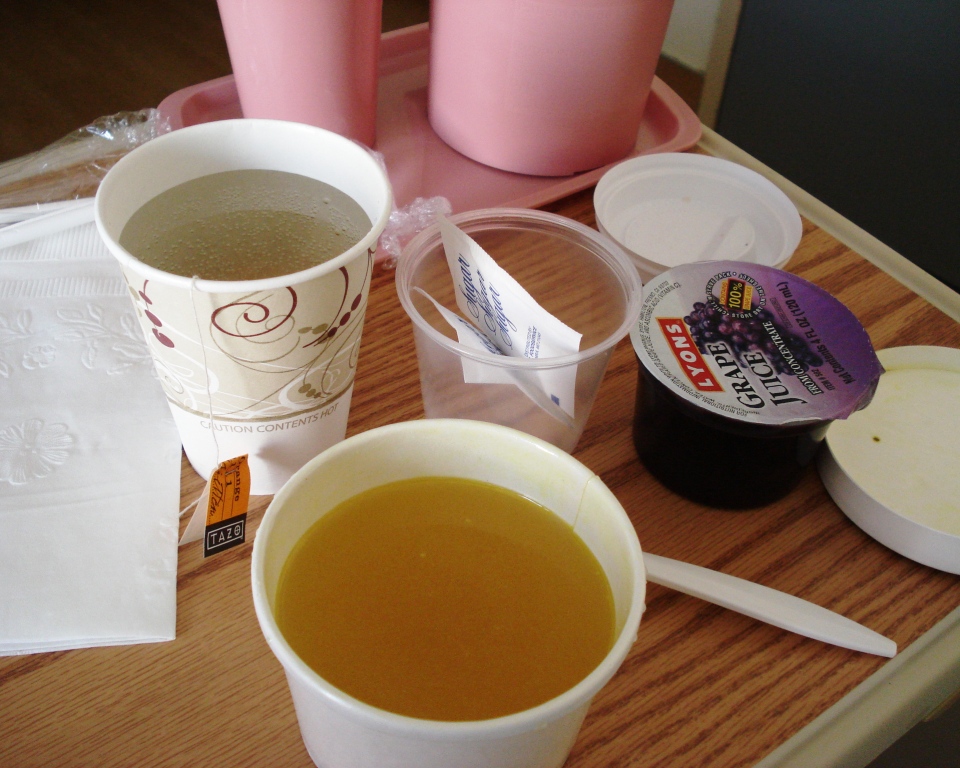
Breakfast is broth, herbal tea, and juice. I'm told that the popsicles featured on the lunch menu are a MUST!

Continuing the spa-like feel of all this, I just need to look out the window of my room. It looks west over Santa Monica, and there's a view of the ocean.


With this and all the support and good wishes from friends and family - can anyone be luckier than I am right now?

Wednesday, May 25, 2011

Pre-op Prep

Before undergoing major surgery, patients should prepare their bodies for the ordeal ahead. Follow a few simple rules so that you will enter the operating room in the best possible condition.

In addition to the less pleasant matters of preparation prescribed by my doctors, I think a fresh pedicure and a new haircut should put me in the proper frame of mind for the days ahead.

That's the best I can do. Wish me luck!

Sunday, May 22, 2011

Stones in a sock - and other news

Street sculpture at my hospital
Friday, I visited my surgeon's office the last time before my colectomy surgery. I'm in pretty good shape, and everyone is optimistic.

The surgery takes place on Wednesday. Tuesday I have to prepare my body for the surgery. If you've ever had a colonoscopy, the preparation is similar. You drink an enormous amount of a laxative solution, and spend the entire day within running distance of the toilet.

In addition to that, I have to take some powerful antibiotics to kill off all the helpful bacteria that normally aids digestion. Part of the recovery process is having the bacterial environment in my gut come back to its proper ecological and functional balance.

And that's all before I even get to the hospital.

Wednesday, May 18, 2011

Dining Alone - Dining while ailing

Sometimes you Dine Alone simply because you can't dine with others. I don't mean you have to be separated from them physically - but for some people, your personal condition makes you unable to enjoy and share a meal with others.

Those who are ailing experience that. And so you sit, sipping your broth and nibbling your saltines while others tuck into a hearty stew or sizzling steak, companionably together at the same table but oh, so apart in taste, sensation, and - sometimes - satisfaction.

It's difficult to avoid dissatisfaction. No matter how delicate, how finely seasoned, how fresh the ingredients of your potage or pap, it's hard not to covet a slab of grilled meat when it's there across the table, in front of your companions.

And they - if they are kind and empathetic people - find it difficult to enjoy their char-broiled morsels while you sit nibbling your pale and limp noodles.

Perhaps this is why, in many cases, the person who is ill has the upper hand, and commands the stomachs of the entire household. Food writer M.F. K. Fisher wrote of this dynamic from the point of view of the non-ailing, as her grandmother's "nervous stomach" set the menu for her family as she grew up:

"We had a fine time when she was not there, mostly in the dining room. Nothing made us secretly happier than to be told that next week she would have to leave for Battle Creek or even for a week or two in Long Beach for a religious convention. It made our mouths water. No more pale bland overcooked unseasoned barely palatable food, adapted to her gastric requirements as established by the Sanitarium diet kitchens! No more Boiled Dressing on watery lettuce! No more "plain" stewed hen, with meaningless dumplings in  gravy equally without either taste or color. No more stewed tomatoes with pink soggy bread in them!"
Fisher claims that her childhood accommodation of her Grandmother's Nervous Stomach "undoubtedly influenced my whole future, with its dictatorial rumblings and belchings." The combined  awareness, frustration, and sense of guilty pleasure gave the young Fisher something to focus her writing talents upon.
"It is plain to me now that our grandmother's gastric peculiarities nurtured all our latent sensuality and gourmandise."

It's telling that among Fisher's most notable accomplishments of food writing was her translation from the French of Jean Anthelme Brillat-Savarin's "The Physiology of Taste, or, Meditation on Transcendental Gastronomy."

The 18th century epicurian had strong views on the enjoyment of food. Brillat-Savarin had little patience with doctors and their prescriptions of sickbed diets:
"From the minute one has the misfortune to fall in their hands, they submit him to a procession of prohibitions, and make him renounce everything enjoyable in his daily habits.

I protest against most of these interdictions of useless.

I say useless, because sick people almost never benefit from what is unpleasant to them.

A sensible doctor must never lose sight of the natural tendancy of our preferences, nor forget that if painful sensations are depressing by their very nature, those which are agreeable lead perforce to our well-being. It has often been seen how a little wine, a sip of coffee, or a few drops of liqueur will bring back a smile to the face of the most hopeless invalid."
Perhaps he was right. I haven't yet had taken a chance on a little wine or a few drops of liqueur, but yesterday, in spite of my diet's restrictions on strawberries, I still allowed myself a wee sliver of my friend Dorothianne's strawberry-rhubarb pie.


And I am all the finer for it.

Tuesday, May 17, 2011

Pain on a scale of one to ten

Gargoyle, Notre Dame de Paris
One of the questions they kept asking me in the hospital was how I would rate my pain on a scale of one to ten.

I'm told that diverticulitis is quite painful, and every new caregiver I encountered asked me with great concern whether I was taking pain medication or whether I wanted some.

After seeing my CT scan, one of the doctors in the surgical team went to find me on my gurney in the ER, expecting that a patient with such a acute condition would be in great distress.

He found me leaning back on my pillows reading a book. Yeah, I was uncomfortable. Yeah, it was painful. But when he asked me the "on a scale of one to ten" I had a hard time answering. Four? Six? Five?

So what is pain, and how do we perceive it?

Friday, May 13, 2011

Who's whining?

Well, isn't it convenient that Blogger crashed and wiped out all evidence of my temper tantrum about not being able to have a glass of wine with dinner.

UPDATE - Whoops, no it didn't. It's back now.  

Monday, May 9, 2011

Phlegmon and Fistula


Phlegmon and Fistula - no, they're not characters from a Baroque opera by Haydn, a Commedia dell'Arte farce, or an ancient Greek poem. Phlegmon and Fistula are brand new words in my vocabulary. They put the "complicated" in complicated diverticulitis.

I've thought a lot about whether to write about my medical adventures. Is it interesting to anyone but me? Who wants to bore friends and relatives with endless details about an illness?

Plus, my complaint is not a pretty one.No major illness is, when you get down to the details. Although Puccini and Dumas transcended the horrors of tuberculosis to make it the romantic stuff of novels and opera, I can't see how to pretty up colon disease.

But I have reasons for writing.

One reason is to let people know about it. Lots of people in my generation may face this situation. Colon disease, and particularly diverticulitis, is mostly caused by the way we choose to live - diet.

The other reason is - writing is just how I deal with things.

So - fair warning. I'm writing about it. If you don't like it, don't click on the "Read More" link.

Weighing in

After IV fluids, jello looks pretty darn good!
Another Monday, and another Weight-Watchers weigh in. Of course, this Monday like last Monday is different - this is after my diagnosis with complicated diverticulitis, and I'm on a very different diet than Weight Watchers point system..

Still, it's good to keep a record of what I eat and how my body reacts, and the Weight Watchers online system is a great tool.  And wouldn't you know it - I've earned a star today. I've lost 5% of my starting weight!

What's my glamorous secret?

The diet I'm following is called a "low residue diet", and its purpose is to get enough nutrients through me to keep me alive without making my bowels work too hard. The emphasis is on low fat and low fiber.


That's right, LOW fiber. It's funny, because a diet too low in fiber, high in fat, and high in processed foods is probably what got me here in the first place. The long-term goal for a diverticulitis patient is to gradually adopt a high fiber diet once your gut is fully healed.

Hospital cafeteria powdered eggs. Yuk.
But for now, while my innards are still recovering, I'm eating the diet of an invalid. I have a table I follow with columns that show "foods to enjoy" and "foods to avoid."

On the "Enjoy" side - White bread. Cooked cereals, Rice Krispies, white noodles, mashed potatoes (no skins). Vegetables cooked to a mush. Tender meat and protein, blamelessly soft or ground, and without gristle, fat, or stringy bits. Cooked fruits or certain non-fibrous fruits like melon and banana. Applesauce, yogurt, jello.
Squash soup - OK
Pureed vegetable soups or chicken noodle soup. Tea and clear juices are okay.

I eat a lot of tuna sandwiches and cups of chicken noodle soup
On the "Avoid" side are  - Whole grain breads or rolls. Pumpernickel. Wild rice, kasha, bran cereals, coconut, dried fruit, berries, raisins. Raw or partially cooked vegetables. Fibrous meats with gristle.

Everything in the cabbage family is forbidden.

Beans and legumes. Onions.Peanuts, pickles, olives, relish and popcorn. All on the "Avoid" list.

Not allowed
No alcohol. This is listed in the diet, but it's also forbidden during my antibiotic regimen, because it reacts with one of my medications.

Nope
This isn't really hard, because my gut feels sensitive and I'm not craving what I can't have. I expect this might change as I get better.

Nuh - uh


No way


Don't even think about it.
There are other foods that aren't mentioned in either list, but I'm temporarily avoiding them to be safe. And some of these are things I simply adore.

Tacos Cochinita pibil
The coarse masa meal in tortillas might be trouble, also the fatty and fibrous roast pork and pickled vegetables. Sigh.

Barbecue from J & J

Barbecue ribs and baked beans are no-go. I can eat the soft white bread, though.

Oaxacan Horchata with chunks of fruit, cactus syrup and pecans
Raw fruit and nuts are forbbiden.

Sichuan hot sauce
Hot chiles, oil, and peanuts - a trifecta of things I must avoid now.
 
I'm trying to see if some of my favorite foods will fit my regimen. Sushi, for instance. White rice and tender protein - that would work, right? Or is there an issue with raw fish?


Are oysters on the half-shell allowed?

I experimented the other day with California rolls made with fake Krab, and it seemed fine.
Delicious Pho
How about Vietnamese pho? Clear beef consomme, rice noodles, tender beef? No Sriracha sauce, and no raw bean sprouts, but otherwise, it could be a soothing, delicious meal.

All in all, I feel like some toothless codger gumming soft white pap and inconveniencing my dinner companions. "Sorry," I found myself apologizing to a waitress for leaving half a tuna sandwich on my plate, "I'm on a limited diet."

I've always felt slightly superior to people with picky diets. Now I am one, at least temporarily, and I suppose my experience will make me more sympathetic.

What foods soothe you when you're sick?

What foods do you miss when you're under the weather?

Friday, May 6, 2011

Weekly check-up


It's been a week since I went to the Emergency Room and was diagnosed with complicated diverticulitis.

I spent three nights in the hospital - one night in a ward where I was hooked up to all kinds of monitors and forbidden even a sip of water, and two nights in another ward where I was allowed a liquid diet, and then, gradually, real food.

Not surprisingly, my weekly Weigh-In on my Weight Watchers tracker, was awesome!

I'm home now, with a complex regimen of medications, and a strict diet to follow. I spent two days at home, then I went back to work. Frankly, I need to go back to work - I'm going to need those banked sick leave days later on.

It hasn't been that bad. I have a kind boss, sympathetic co-workers. I sometimes get tired in the middle of the day, after eating my bland and meager lunch, but other than that, I'm OK.

Today I went to see the Surgeon assigned to me. After a bout with diverticulitis, some people manage the condition with diet and antibiotics alone, but with the complications I have, surgery is the logical option. The strategy is to get my innards to the peak of health with antibiotics and diet, and then schedule the surgery.

The recovery from the surgery is about three weeks - a week in the hospital back on IV fluids, then graduating first to liquid diet and then to the diet I'm on now. Essentially - other than the new experience of having six inches of my gut snipped out, it will be a repeat of what I've gone through this week all over again.

My doctor is pleased with my progress so far. We've marked the calendar. Now, my job is to follow the directions and stay healthy.

I am so coming out of this thing a size 8.

Tuesday, May 3, 2011

What I got

It's called "complicated diverticulitis." And there's no pretty way to talk about it.

Whatever you call them - intestines, vicerae, bowels, entrails, guts - everybody's got 'em.

The human small intestine is a tube about 18 - 23 feet long and 1 inch in diameter, jumbled up in the middle of our bodies. It extracts most of the nutrients from our food after it leaves the stomach.

Whatever's leftover passes into the large intestine, or colon, which is about 5 feet long and maybe 3 inches in diameter.

The large intestine runs in a kind of squared circle around the coil of small intestines, then drops down to - well, the exit hatch. The colon extracts water so that the final product that leaves the body is relatively compact and manageable.


The inside of the intestine is a tube lined with cells that do different jobs. Some cells secrete lubricants to smooth the material along its way. Other cells have multiple folds that increase the surface area exposed to the material. There are layers of muscle that contract to propel the material along; also elastic cells that help the intestine stretch and contract to accommodate varying capacities. Blood vessels feed oxygen to the cells of the intestine.

The intestine's outer walls contain padding to protect them from friction damage from the body's other moving parts, and a final covering that further cushions and separates them from other organs, and keeps them in their proper place.


It's like a hose with multiple layers; some for protection, some for strength, some for flexibility. Then it's padded and enclosed and strapped down for stability.

For some people, the inner layers of the large intestine develop little pouches. Maybe during some of the roiling contractive movements, a bit of the inner membrance pooches in between lining muscle fibers and make a little outward dimple.

These little dimples or pouches are called diverticulae, and diverticulosis is the word used if you have them. People with diverticulosis live normal healthy lives without incident - unless the diverticulae get sick.

What would make them get sick? Well, with all that matter coursing through the gut, some gets trapped in the diverticulae, and impact them like food particles stuck in your gums irritate that tender tissue. Whatever the reason, a large intestine with irritated diverticulae triggers the body's defense mechanism, causing nausea, vomiting, fever, cramps and pain. When you have inflamed - or sick - diverticulae, it's called diverticulitis.


Diverticulitis most commonly appears in the sigmoid colon, which is the portion near the end of the run, where the colon turns the corner and makes a horizontal kink before feeding into the rectum. Why I don't know - probably gravity has something to do with it. Perhaps it takes more pressure to move material along, perhaps sludge collects along the bottom of the tube.

When diverticulitis goes untreated, bad things happen. An infected area can become so weak it perforates or ruptures. When it ruptures, it releases the matter from the pipeline into places it's not supposed to be.

You'd think the term medical professionals use when this happens would be some big Latin word. But it's not - the term is a simple vernacular phrase "complicated diverticulitis."

I was lucky. For me, the trouble happened in a place where the leak was contained; my immune system kicked in successfully; and the timing was fortunate.

Next step? I'm on a course of antibiotics to heal the inflammation, and I'm following up with my doctors. Not all cases of diverticulitis result in surgery, but complicated diverticulitis increases the likelihood. We'll see what develops as I continue to heal.

There's a lot more to diverticulitis than what I've said here. It will be a learning process I'm going to be following for the rest of my life. If you're interested, stay with me as I go through it.

Monday, May 2, 2011

Hosed

While I was in the hospital, listening to the doctors talk about what's gone wrong in my guts, and what it will take to heal and repair everything, all this talk of tubing and perforations and cutting out damaged parts reminded me of something. There was something familiar tugging at the back of my mind I couldn't quite get. An image. An analogy. A memory....

YouTube screen captures, Broadway production of "Miss Saigon", performed by Jonathan Pryce at the 1991 Tony Awards.

At the climax of the blockbuster Broadway show "Miss Saigon", the leading male star has a big production number. He's a con-man, a grifter, a pimp, and his exploitation of a tragic young girl is about to pay off big time.

As he savors this victory, he daydreams of his future in America. Night clubs, dancing girls, chocolate eclairs, champagne - visions of these luxuries dance across the stage until at last, the ultimate symbol of his American dream appears.

It's a 1959 Cadillac convertible, double headlights flashing as it descends through the clouds, its toothy grille glittering with a thousand LED lights. And as its sleek frame glides downstage toward him, you can see the liveried chauffeur and, perched on the back, a beauty queen, sashed and wearing a Statue of Liberty crown.

Miss Chinatown's costume lights up and her car-seat elevates

The con-man flings himself on the polished hood of the car, fondles its headlights (wink wink!), writhes in obscene ecstasy, and then falls, as his vision evaporates into nothing.

Although I didn't create this effect, for five years it was my responsibility to fulfill the con-man's vision on a regular basis. The Cadillac car effect in "Miss Saigon" is an extremely complicated stage prop. At base, it's a "truck" or "wagon" - a platform hooked into the tracks of the automated scenery system embedded in the stage. The car itself is set onto the truck, and conveyed downstage for the scene.

To accommodate the cramped theatres on the tour's itinerary, our Cadillac was fore-shortened. It was chopped in half at the windshield, the front half stacked on top of the back half, mounted on a kind of hydraulic arm. As the wagon glides downstage, the car's grille and hood fold down in front of the rest of it, so by the time it emerges into the spotlight downcenter, the Cadillac appears long, sleek, and intact.

That's complicated enough, but in addition to that, it has flashing lights, spews dry-ice fog, and has two live actors inside.

Here's an article about our tour from a 1999 Honolulu newspaper that includes a small photo of our Cadillac.

If you think about this, you realize how difficult a piece of engineering this is. It has to have a frame that's flexible enough to hinge over itself, and yet sturdy enough to ballast the leverage. It must be strong, yet cradle its fragile, fleshy cargo within.

Through this steel frame threads a network of cables carrying electricity for lights, hydraulic lines, and data lines.

Separately, four-inch hoses and pipes feed through the car to route the fog from a port at the tailpipe that attaches to a steam boiler where baskets of dry ice are lowered.

Like the wires, hydraulics, and cables, the hoses must be slack enough to flex as the car is folded, yet taut enough not to drag or snag when the car is opened. All these parts must be carefully routed to avoid being pinched by moving parts, and padded against friction and wear.

And it must be able to do all these things while constantly functioning. Our show ran 8 days a week for over five years.

I was responsible for the lights and the fog, and also for connecting power and data. Everything plugged into a panel with a half-dozen multi-pin connectors and plugs, plus a big tailpipe to clamp the fog hose onto. This all took place in almost total darkness.

This screen-capture inadvertently reveals the stagehand doing the same job I did. Look above Pryce's elbow

Lots of things could go wrong, but usually it was the fog hose. Sharp objects tore holes in it, snags stretched and broke it. Sometimes it slipped off the tailpipe. Holes spewed fog from the wrong place. On the other hand, kinks as the car unfolded or condensation water collected in low-sagging areas blocked the flow of fog. One memorable day, with a hot boiler, pressure from the dry ice drop blew the feeder hose off, shrouding all of backstage in impenetrable fog, but leaving the car's works starkly revealed on stage.


Maintenance was a constant. I used a lot of duct tape. I'd cut out a shredded section and rejoin the ends. We made a black velour "sock" to contain fog leaks. The critical link that hinged with the moving arm was too fragile for its task, so we searched the industrial zones of South Seattle and found a sturdier material. Every city we went we looked for newer and better hose.

The boilers needed maintenance, too. Elements burned out, wiring overheated, fuses blew. The huge steel bellies were drained and cleaned when we moved the show to a new city. Some cities had bad water - a silty, foul deposit collected that I flushed with a Shop-Vac.

"Car Wreck - Classic Car Cadillac de Ville" - Image by Reinfried Marass, with thanks

I remembered this experience vividly, after my recent stay in the hospital. I still have a Cadillac I'm responsible for. It's an aging one that works too hard; its system needs a clean-out and its tire-tread is thin. Its hose is kinked and snagged and sometimes clogged. A few wraps of duct tape have done the trick this time, but eventually, we're going to need to trim out some shredded sections and stick it back together.

To watch Jonathan Pryce perform "The American Dream" at the 1991 Tony Awards, go HERE.