Showing posts with label architecture. Show all posts
Sunday, August 28, 2016
Magnificent ruin
I was driving out to see friends yesterday when ahead at the corner of Broad and Orleans I could see the blue flashing lights of police motorcycles, and a crowd of people in black and gold spilling out into the street.
In any other city you might think there was an accident or some kind of emergency, but this is New Orleans - it had to be a funeral second line. It was also right where the Zulu Club's headquarters is on Broad Street, so it was obviously the rites for someone prominent in the community.
To avoid traffic, I cut across the neutral ground and headed uptown a couple blocks. Suddenly, I came upon a most fantastical sight - the crumbling Art Deco ruin of the General Laundry and Dyers building on St. Peter Street.
This building was built in 1930, registered as a National Landmark in 1974 by preservationists,
Its brilliantly colored red, green, blue and yellow terra cotta tilework makes it unique among Art Deco buildings, most of which are more subdued in color.
It is owned by the Southern Recycling Company, which for several years has been seeking permits to demolish it.
Labels:
architecture,
art,
New Orleans
Saturday, August 16, 2014
Opulent banality
The Hearst Castle Visitor Center is some 1500 feet below the hilltop where William Randolph Hearst's monumental self-indulgence is built. The parking lot is huge, and on the Saturday we visited, completely full of cars. We cruised the rows before giving up and parking, along with other visitors, in the dirt off the access road.
Inside the center, shops and restaurants lined a vast glass-arched central atrium, teeming with people. The ticket line doubled back on itself four rows deep. When we finally reached the front and received our wristbands, there was still a half hour before we could board the bus that would take us on the five-mile ride to the castle.
Labels:
architecture,
Travels
Sunday, March 16, 2014
Downtown gala
![]() |
| Sculpture at the Gala |
It presents innovative, often experimental performing arts and music in a beautifully designed black-box performance space located in the amazing Walt Disney Concert Hall, designed by Frank Gehry. This building is quite rightly one of the crown jewels of Los Angeles' cultural scene.
Along with the Dorothy Chandler Pavillion, the Mark Taper Forum, and MOCA, the museum of contemporary art, and other cultural facilities clustered together in downtown Los Angeles, the Concert Hall is part of the Grand Avenue Project. A massive development conceived by LA's movers and shakers, the project aims to transform this part of downtown into a vital, pedestrian-friendly site, with parks, housing and activities.
![]() |
| Walt Disney Concert Hall from upper Grand Avenue |
But when you attend an event here, you don't see that at all. When you drive to Disney Hall - as most event guests do - you exit the freeway at 4th Street and glide through curving ramps of concrete and the foundations of skyscrapers, watching anxiously for the directional sign leading to a turn-off lane. This lane puts you in the bowels of Grand Street beneath the Music Center. It's a dark tunnel, punctuated by garage-like openings, dotted here and there with orange and white A-frame barricades and traffic cones.
![]() |
| Lower Grand Avenue beneath the Music Center |
You park and look for the way out. On an evening with a Philharmonic performance, you might see scores of suited gentlemen and dressed-up ladies, high heels click-clacking on the concrete ramps, walking through the rows of parked cars to a central escalator. Concert-goers rise up into the main hall lobby; guests to the small venue follow signs back into the parking garage, and enter the theatre from there.
At the end of whatever transformative experience one has in these beautiful temples of art and music, one leaves the same way, through the echoing parking garage and the dark tunnel. Last night, I never saw the exterior of Mr. Gehry's celebrated building, though I was standing inside it. This architectural marvel, for all I saw of it, could have been a concrete bunker.
![]() |
| Palacio de Bellas Artes, Mexico City |
How wretched and shameful is it that in Los Angeles, the pathway for our city's arts patron is so ugly and disconnected from life? How can the arts ever hope to connect with people if they have to sneak in through the loading dock for access?
Whether you are an affluent season ticket holder from the Westside and Beverly Hills, a student purchasing discount tickets, or a new audience member responding to outreach efforts, if you drive in, this shabby tunnel will be your welcome to the place.
![]() |
| Disney Hall on upper Grand Avenue |
Last night as our car emerged onto 4th Street from the tunnel, our headlights flashed across the huddled figures of homeless people, sleeping beneath the concrete overhang. Here's one way, I guess, that the arts complex serves this population - providing shelter from the cold night.
What planner, what traffic engineer conceived such monstrosity? Did they really intend to create such a glaring symbol of the void between the city's creative establishment and its citizens? To confront guests with the city's harsh reality, after their interlude in fantasy?
The desserts were wonderful, though!
Labels:
architecture,
art,
L.A. Excursions
Tuesday, February 25, 2014
Shadow message
In 1990, when televangelist Dr. Gene Scott bought the 13 floor Gothic-Art Deco office building where the United Artists Theatre is located, he installed two huge neon signs on the roof. "Jesus Saves," they proclaimed to the world and to the few remaining inhabitants of lower Broadway in downtown Los Angeles. The message was large and bright enough to be seen by the sweatshop garment workers toiling in nearby lofts, and the people lining up at Tacos Mexico in the parking lot.
Scott's estate sold the building in 2011, and this January it re-opened as the trendy Ace Hotel, complete with a restaurant, pool, and a very cool rooftop bar.
One sign disappeared in the night during the renovation, its whereabouts still unknown. The other still stands, facing west.
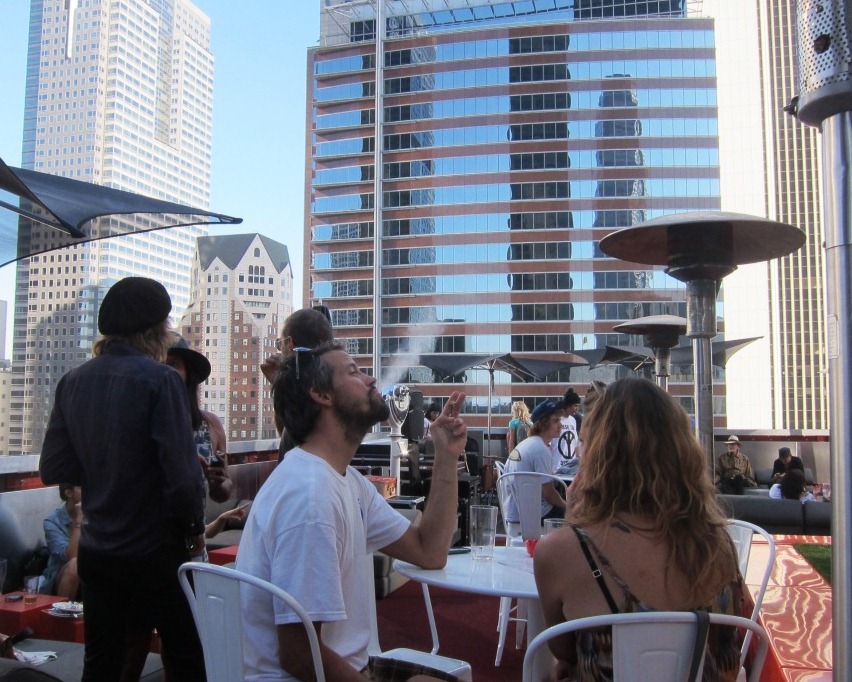
From the rooftop bar, at the right time in the afternoon, the sign's shadow can be seen, thrown against the flat surface of the building to the north. As you sit, beneath faux-Morrocan awnings, sipping hipster cocktillian concoctions, behold.
UPDATE: Here's a link to a story that gives the history of the "Jesus Saves" signs: http://jesussavessign.blogspot.com/
Scott's estate sold the building in 2011, and this January it re-opened as the trendy Ace Hotel, complete with a restaurant, pool, and a very cool rooftop bar.
![]() |
| Ace Hotel facade |
From the rooftop bar, at the right time in the afternoon, the sign's shadow can be seen, thrown against the flat surface of the building to the north. As you sit, beneath faux-Morrocan awnings, sipping hipster cocktillian concoctions, behold.
UPDATE: Here's a link to a story that gives the history of the "Jesus Saves" signs: http://jesussavessign.blogspot.com/
Labels:
architecture,
cocktails,
history
Saturday, February 22, 2014
Fashion district
There's a sign on a pole as South Spring Street crosses 7th Street in downtown Los Angeles that says "Fashion District." The center of the garment industry on the West Coast, this 90 block area of town includes retail stores, wholesale distributors, supply and material dealers and factories, as well as schools to train young designers and manufacturers. It encompasses the southern portion of the historic core and runs south and west where low concrete block warehouses line potholed streets.
Here at Spring Street, gentrification hasn't quite touched the old buildings, which are still shabbily beautiful. At 721 S. Spring, we would have completely missed the California Millinery Supply, if it weren't for the sign in the window.
A single piece of white paper was stuck on the glass, in front of the white, winged shapes that were buckram hat frames. "Thoughts," it said, in ornate fraktur script. And a list:
- The greatest handicap Fear
- The best day Today
- Easiest thing to do Find a fault
- Greatest thing in the world Love
![]() |
| The doors |
"Come in, you can look around." The voice came from a grey-haired woman sitting behind a desk. A long-haired grey cat uncoiled itself and jumped down from a chair it was sleeping in, and scurried to the back of the space.
The rows and rows of shelves were lined with braid, ribbon, piping, fringe. There were boards holding samples of silk flowers. The whole place looked like a treasure chest to explore.
"It's funny," I said. "I never wear hats, but now I find myself wanting to make them!" When we stepped back outside and looked up at the curiously beautiful building, we noticed, up high in a protected niche, a colorful figure of a standing Buddha.
California Millinery Supply has been at 721 S. Spring Street since 1939.
Labels:
architecture,
fashion,
history,
L.A. Excursions,
shopping
Tuesday, June 4, 2013
Thematic Photographic - Concretely
Carmi at the blog "Written, Inc."
posts a photographic challenge each week at Thematic Photographic. This week, the theme is "Concretely."
What is concrete, anyway? This versatile building material can be used in so many ways, it's a kind of chameleon or shape-shifter - it can be heavy, solid, hard and weighty but in other hands it can be something else entirely.
Here in the Mid-Century Modern facade of the Santa Monica Civic Auditorium, a wall of concrete blocks transcends its own mass and becomes airy, transparent, and brings light to the upper floor.
This feature is called out in landmark documents for the building as a "brise-soleil," French for "sun-breaker." What a wonderful name that is for an architectural feature.
What is concrete, anyway? This versatile building material can be used in so many ways, it's a kind of chameleon or shape-shifter - it can be heavy, solid, hard and weighty but in other hands it can be something else entirely.
Here in the Mid-Century Modern facade of the Santa Monica Civic Auditorium, a wall of concrete blocks transcends its own mass and becomes airy, transparent, and brings light to the upper floor.
This feature is called out in landmark documents for the building as a "brise-soleil," French for "sun-breaker." What a wonderful name that is for an architectural feature.
Labels:
architecture,
Thematic photographic
Monday, October 8, 2012
What condition my condition was in
| Hipsters in their natural habitat |
The Standard Hotel in downtown LA is part of a chain of "boutique" hotels known for their fashionable and hip vibe. Transforming a staid 1956 office building once owned by the Superior Oil Company, the Standard opened in 2002, splashing onto the pages of architectural and travel magazines for its unique, creative and quirky modern design. It also had a reputation as an exclusive place for the young, celebrated, and hip to party. But now it's 2012, on a beautiful Sunday afternoon, so why not stop in for a glass of wine and a chance to see what all the buzz is about?
Labels:
architecture,
L.A. Excursions,
Mad as hell,
Memories,
music
Wednesday, September 12, 2012
Art in the Palazzo
![]() |
| Palazzo Grimani Museo entrance |
Sometimes this works out harmoniously - the beautiful Baroque Ca' Rezzonico, which was completed in 1756, houses the Museum of 18th Century Venice. The artifacts are displayed in rooms that are themselves displays of 18th century architecture - a wonderfully evocative way to experience it.
Labels:
architecture,
art,
Travels,
Venice
Monday, September 10, 2012
Above it all
![]() |
| For all photos - click to "embiggen" |
A top-floor restaurant with a magnificent view is a great attraction for a hotel - so many cities have them it's become a cliche. Some are attractions due to superlatives - the bar at the top of Chicago's Sears Tower, for example. Others are attractions for their show-biz trendiness - Los Angeles has enough of these to fill a travel book. Other smaller cities have them too - one in Indianapolis rotates as you dine.
Fashions come and go - but even when dated and drear, like a sad, deserted joint at the top of a frumpy hotel I once visited in Raleigh, NC, there's always something special about a place with a view.
Labels:
architecture,
cocktails,
SoCal Excursions
Sunday, August 5, 2012
Tacos and tunes
Yesterday was the Second Annual Los Angeles Taco Festival in Boyle Heights.
Modest as festivals go, it isn't complicated. It's all about eating tacos, hanging out, and listening to music in Mariachi Plaza.
Labels:
architecture,
art,
books,
food,
L.A. Excursions,
music
Saturday, August 4, 2012
One point perspective
| South Kensington tube station, on the District Line, London. Click to "embiggen" |
All elements that are perpendicular to the viewing frame converge at a single point (a vanishing point) on the horizon.
Ancient artists - the Greeks, the Egyptians - were aware of this phenomenon, and many works of art from those era show attempts to depict a sense of depth in a two-dimensional work. Medieval and Byzantine artists also tinkered with these ideas - but in many works, the relative status of certain figures caused these spatial ideas to be applied inconsistently. When you have to draw saints or donors larger than ordinary people, you tend to get the proportions out of whack.
It wasn't until the Eleventh Century that somebody figured out the math of perspective. The Islamic scientist and mathemetician Alhazan - born Abu Ali Al-Hazan ibn Al-Hasan ibn Al-Haytham in the city of Basra in what is now Iraq - was a civil servant working in Cairo. He developed the modern science of optics, studied the anatomical function of the human eye, and is credited with being the first scientist to explain how rays of light work.
Expanding on the writings of Alhazan, Italian artists such as Lorenzo Ghiberti and Fillipo Brunelleschi developed the geometrical methods of drawing in perspective.
As a theatre student in college, my design professors used to assign me the trick of turning a floor plan into a graphic rendering, by simply using the geometrical formulae of perspective drawing. Or - conversely - to take a Renaissance perspective drawing and turn it into a spatial floor plan.
A photo like this one makes my fingers itch for drafting pencil and a T-square, to see if I can do it again.
Labels:
architecture,
art,
history,
Travels
Sunday, July 15, 2012
Up on the roof
![]() |
| Don't forget - you can click all photos to "embiggen" |
Labels:
architecture,
art,
music,
Travels
Sunday, May 20, 2012
Music in the library
This neighborhood is one of Los Angeles' oldest, with many of the buildings dating from between 1880 and 1925, It was once the home of LA's wealthiest founding fathers, and after the Supreme Court struck down segregationist covenants, it became the home of LA's wealthy and prominent African American community.
Construction of the 10 freeway cut through the neighborhood, destroying many fine homes, and the neighborhood declined in the '60s and '70s. But today it's coming back as preservationists, USC academics, and others discover neglected beauties among the mix of shabby Craftsman bungalows, pillared mansions, and stucco'd apartment houses.
But in this block on the north side of West Adams Boulevard, between Gramercy and Cimarron, there's another Los Angeles treasure to discover.
Labels:
architecture,
art,
books,
L.A. Excursions,
music
Tuesday, January 24, 2012
Design for sunshine
This exhibition features mid-century modern design for living - the objects, graphics and structures that were part of everyday life. For people my age, these designs are not just art - they are part of our memory, because we lived them. As I walked through the displays, I was overcome at every turn by how familiar this was, personally, to me.
The show encourages these rushes of memory, as it includes not only fine works of design but also everyday things like kitchen utensils, record album covers, toys and even cars - a classic Avanti is among the many displays.
As soon as you enter the exhibition, you encounter a polished and gleaming Airstream trailer - the "Clipper," designed in 1936, its aerodynamic shape and construction inspired by the airplane industry.
Labels:
architecture,
art,
L.A. Excursions
Monday, November 14, 2011
Marathon in high heels
This has been a marathon weekend - on the social front.
![]() |
| Disney Hall, interior |
![]() |
| Disney Hall exterior, at night |
On the downside - tired feet!
Labels:
architecture,
music,
The theatre
Monday, July 25, 2011
The view from the Pagoda
If you take a right turn at Sycamore Street, off Franklin Boulevard in the heart of touristy Hollywood, you'll find yourself on a narrow road that winds up into the hills. Pass through the gate and follow the directions of the attendant, and you'll find yourself pulling up at a valet stand in front of an amazing Japanese palace, with one of the best views in town.
Labels:
architecture,
L.A. Excursions
Thursday, July 7, 2011
Xanadu by the sea
![]() |
| The Royal Pavilion seen from the park and gardens |
He bought a modest farmhouse a short walk from the pebbled beach, and as the years passed he improved upon the property. In 1815 he engaged the architect and designer John Nash, who turned the modest Sussex farmhouse into an extravagant, almost hallucinogenic, sprawling fantasy palace known today as the Royal Pavilion at Brighton.
In the midst of the town of modest attached houses and pubs, pale stucco turrets, minarets and bulging onion domes rise over a green lawn and winding, flower-filled gardens. The exterior style is an amalgam of Saraceno-Indo-Islamic Arabian Nights on acid. The interior is one of the finest and most overblown example of Nineteenth Century Chinoiserie ever created.
![]() |
| Entry |
And then you enter the Banqueting Hall. It's a huge domed room encrusted with decor - the walls are painted with Chinese scenes, the windows crested with pelmets fashioned to resemble writhing dragons; great banana leaves of bronze and gilt top the dome and from them a huge silver-gilt dragon bearing a crystal chandelier is suspended.
![]() |
| Click to "embiggen" |
Tourists are not allowed to take photos of the interior, so you'll have to be content with this contemporary print of the Banqueting Hall.
Nash's designs were state of the art. The building was built with the latest technological advances - a frame of iron clad in stucco was innovative and allowed for the fanciful domes and shapes of the building. Even the kitchens were designed with the latest - a specially engineered contraption used the power of the wind to turn dozens of trussed birds roasting on spits. Nash allowed the kitchen slaveys a bit of fancy, too - the cast-iron columns in the room are topped with palm leaves, as though trees are holding up the high ceilings.
![]() |
| Kitchen at the Brighton Pavilion (sorry, no larger resolution) |
| The Prince Regent, painted by Thomas Lawrence, circa 1816 |
The upper floors include the suite Queen Victoria used the few times she came to Brighton. You can even see her maid's bedroom and the royal commode. There are also suites that housed George IV's brothers, the Dukes of York and Clarence, decorated in a searingly vivid chrome yellow, with dragon-patterned panels.
Victoria disliked Prinny's elaborate fantasy, finding it vulgar and not a good place to raise children. In 1850 she sold the building to the City of Brighton at a cut-rate price - after stripping it of most of its furnishings and fixtures.
The town used it as assembly rooms - no doubt the tourism trade provided a good market for meetings, ballrooms and the like. King George IV's fantasy became the first modern example of a municipally owned event facility.
As we toured the upper rooms we also learned of an odd, paradoxical yet fascinating episode in the history of the Pavilion. Between 1914 and 1916, at the height of the First World War, the City of Brighton provided housing for military hospitals in municipal buildings like schools and exhibit halls, and also the Royal Pavilion. The Royal Pavilion became a ward serving wounded troops from the Indian Corps - soldiers from Britain's colonies in India. Over 4000 men were treated there during this time.
![]() |
| Another view from the garden |
![]() |
| Painting by C C H Burleigh showing the Music Room used as a ward |
You can see a Flickr set of images of the Brighton Indian Military Hospital at this website HERE. A nice article about those days is HERE.
After the Second World War, the City began an effort to restore the Pavilion. Queen Elizabeth II returned on loan much of the furnishings that Victoria had removed. Today, the house is beautifully preserved and conservators are trying to recreate its original furnishings and decor.
If you're interested in interior design; a fan of chinoiserie, or interested in seeing what might have been the first true fantasy-land environment, you'll love a visit to the Royal Pavilion at Brighton.
Labels:
architecture,
history,
Travels
Wednesday, June 29, 2011
Overwhelmed
![]() |
| Gamble Room, ceiling detail |
Everything is full of detail and meaning, and resonates its history and place in popular culture.
You know how you can get overwhelmed while visiting a museum? And you decide you have to take it in one or two wings at a time, and save the rest for another day. Well, the city of London is a little like that.
And speaking of museums - we visited the Victoria & Albert Museum yesterday. Even the museum cafe is overwhelming.
The V & A, as far as anyone can tell, was the first museum ever to have a restaurant inside for hungry patrons to rest and eat. The cafe was decorated in a style to showcase current decorative design.
So here is the Gamble Room at the V & A. It was designed by James Gamble and built around 1865. You can enjoy your tuna salad on baguette beneath the ceramic-encrusted columns and arches and the enameled tin ceiling.
And that's just one of the rooms. Another was designed by William Morris.
![]() |
| Victoria and Albert Museum, Morris Room detail |
Labels:
architecture,
art,
Travels
Monday, June 20, 2011
A visit to Ray's house
High on a bluff overlooking the Pacific Ocean, hidden in a grove of eucalyptus trees, is one of America's finest architectural treasures.
It's simple - just two boxes facing one another across a patio, one a working studio for two talented designers, the other a residence.
From Christmas Eve, 1949 and for the rest of their lives, Charles and Ray Eames lived in the house they designed. Ray died in 1988. The house has been kept by their grandchildren exactly as Ray left it.
We visited the house two years ago, and you can read my earlier post about it HERE.
When you think about modern architecture and modern furniture, it's easy to stereotype it as sleek, cold, and inhuman. But the Eames' approach to modern living was anything but. Houses were designed to accommodate work and play, at an affordable cost. They were fascinated with science, nature, and other cultures. Collectors of objects and images, the Eames gathered thousands of beautiful objects. Ray Eames created arrangements that were pleasing to her - whether on the kitchen table, on living room shelves, or in the garden. You can see one of these "shelfscapes" HERE at the Library of Congress. Her garden was as important to her as the house - the potted plants in the patios are arranged as she arranged them.
This photograph by Julius Shulman, from the Library of Congress, shows the Eames in their double-height living room. The room looks very much like this today. The seating nook with built in couches is a warm and cozy hideaway, piled with pillows and soft throws, while the main part of the room is soaring and filled with light, opening onto a sheltered patio.
You can see that they incorporated warmth, fabrics and texture, plants, toys, books and objects into their daily life, belying the stereotype of modern architecture as cold, empty, and uncluttered.
When we toured the house this weekend - as guests of a dear friend who is a member of the Eames Foundation - we were mindful of the prohibition of interior photography. But the intricacy of the space so enchanted me I wanted to record it. So I wrote down a list of what I saw displayed there, to help me remember it all.
Candlesticks in blue, yellow and green glass
Blue onion plates
Oranges cut like flowers
A china figurine of two birds
Salt cellars
Small pillows in checkered fabric
A cookie tin
Books stacked on a bentwood chair
Japanese wooden dolls
Kites
Shells
Cowries
Balinese carved masks
African violets in pots
Abalone shells
Ficus trees
Ferns
A gold-topped coffee table
Pillows made of quilted blocks
Brass bowls
Carved wooden animals
Kachina dolls
A stuffed toy elephant
Polished stones
Indian corn in a basket
A feather fan
Crystal faceted spheres
Pine cones
Walnuts in a basket
Tumbleweed hung from the ceiling
A walrus carved from dark wood, with ivory tusks
Vases with snapdragons, lilies, and ranunculus
If you're in Los Angeles and you want to see the Eames House, you can make an appointment through the Eames Foundation. Regular visits of the grounds are scheduled by appointment, with a $10 admission fee. Some people enjoy simply visiting the site, lying on a blanket in the meadow, and reading a book.
Visits to the house do not include a tour of the interior. These tours occur once a year, on Member Appreciation Day in June. But soon, there will be another way to see how Charles and Ray lived, inside the house Charles once decribed as "life in a Chinese kite."
We learned that in the fall of 2011 as part of the upcoming Los Angeles art event Pacific Standard Time the contents of living room of the Eames House will be carefully moved to LACMA and recreated as an exhibit. This will give a wider audience the opportunity to see this "space for living," and give the Eames Foundation a chance to repair and restore the living room's floors.
It's simple - just two boxes facing one another across a patio, one a working studio for two talented designers, the other a residence.
It's modest - the residence is just 1500 square feet; the studio 1000. It was made with off-the-shelf materials, to be affordable. The designers wrote "The house must make no insistent demands for itself, but rather aid as background for life in work."
From Christmas Eve, 1949 and for the rest of their lives, Charles and Ray Eames lived in the house they designed. Ray died in 1988. The house has been kept by their grandchildren exactly as Ray left it.
We visited the house two years ago, and you can read my earlier post about it HERE.
When you think about modern architecture and modern furniture, it's easy to stereotype it as sleek, cold, and inhuman. But the Eames' approach to modern living was anything but. Houses were designed to accommodate work and play, at an affordable cost. They were fascinated with science, nature, and other cultures. Collectors of objects and images, the Eames gathered thousands of beautiful objects. Ray Eames created arrangements that were pleasing to her - whether on the kitchen table, on living room shelves, or in the garden. You can see one of these "shelfscapes" HERE at the Library of Congress. Her garden was as important to her as the house - the potted plants in the patios are arranged as she arranged them.
![]() |
| click to "embiggen" |
This photograph by Julius Shulman, from the Library of Congress, shows the Eames in their double-height living room. The room looks very much like this today. The seating nook with built in couches is a warm and cozy hideaway, piled with pillows and soft throws, while the main part of the room is soaring and filled with light, opening onto a sheltered patio.
You can see that they incorporated warmth, fabrics and texture, plants, toys, books and objects into their daily life, belying the stereotype of modern architecture as cold, empty, and uncluttered.
![]() |
| Eucalyptus trees on the site |
Candlesticks in blue, yellow and green glass
Blue onion plates
Oranges cut like flowers
A china figurine of two birds
Salt cellars
Small pillows in checkered fabric
A cookie tin
Books stacked on a bentwood chair
Japanese wooden dolls
Kites
Shells
Cowries
Balinese carved masks
African violets in pots
Abalone shells
Ficus trees
Ferns
A gold-topped coffee table
Pillows made of quilted blocks
Brass bowls
Carved wooden animals
Kachina dolls
A stuffed toy elephant
Polished stones
Indian corn in a basket
A feather fan
Crystal faceted spheres
Pine cones
Walnuts in a basket
Tumbleweed hung from the ceiling
A walrus carved from dark wood, with ivory tusks
Vases with snapdragons, lilies, and ranunculus
If you're in Los Angeles and you want to see the Eames House, you can make an appointment through the Eames Foundation. Regular visits of the grounds are scheduled by appointment, with a $10 admission fee. Some people enjoy simply visiting the site, lying on a blanket in the meadow, and reading a book.
Visits to the house do not include a tour of the interior. These tours occur once a year, on Member Appreciation Day in June. But soon, there will be another way to see how Charles and Ray lived, inside the house Charles once decribed as "life in a Chinese kite."
We learned that in the fall of 2011 as part of the upcoming Los Angeles art event Pacific Standard Time the contents of living room of the Eames House will be carefully moved to LACMA and recreated as an exhibit. This will give a wider audience the opportunity to see this "space for living," and give the Eames Foundation a chance to repair and restore the living room's floors.
Learn more about the Eames' work at this great Library of Congress site.
Labels:
architecture,
art
Subscribe to:
Posts (Atom)