Pink Saturday - Beverly at the blog
"How Sweet the Sound" hosts Pink Saturday. Let the color pink inspire you!
 Shawl seen through the window of Wolff et Descourtis, Galerie Vivienne
In 1798, Napolean Buonoparte brought a gift home to his wife, Josephine. It was a shawl woven from yarn made from the hair of mountain goats in the Himalayas. It was soft, but held the warmth, and yet it was light and gracefully complimented the informal, flowing muslin gowns worn by the court ladies which, following the political aesthetic at the time, evoked classical Greek and Roman images, to celebrate the democratic ideals playing out in the streets of France.
 Portrait of Empress Joséphine, 1805, Pierre-Paul Prud'hon
Empress Josephine was being re-gifted - the Ottoman imperial ruler of Egypt, Mameluke Pasha Mehmet Ali, had been given the shawl earlier in the century by an envoy of the Mughal rulers of Kashmir. When Napoleon defeated the Mameluke's army in 1798, the Mameluke gave the French Emperor the Kashmiri shawl in appeasement.
 Empress Joséphine, 1809, Antoine-Jean Gros
Josephine loved it. She wanted more shawls. So, too, did all the fashionable ladies in Paris, and that hunger invigorated not only the weaving industries in India and Kashmir, but also French and British entrepreneurs who decided to import and breed the Himalayan goats and start home-grown weaving industries of their own.
 Images from Journal des Dames et des Modes, New York Public Library
Scholar and social scientist Walter Benjamin, writing about the
covered shopping arcades that sprang up in Paris during the first half of the 19th century, mentioned this fad for Indian cashmere, called "cashmere fever" in newspaper and magazine accounts he quoted in his notes.
 Madame Riviere, 1805, Jean-Auguste-Dominique IngresImage from the Bibliotheque Nationale, Paris
Empress Josephine went on to collect over a thousand cashmere shawls. Every high-class and bourgeoise woman wanted a shawl, and if they couldn't get a cashmere shawl, they wanted something that looked a lot like one.
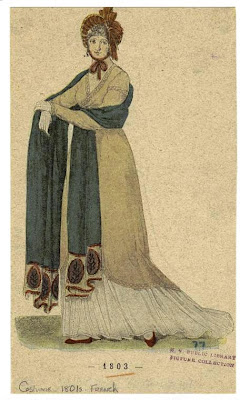 French fashion plate 1803, New York Public Library
It was kind of like back in the 1990s when everyone wanted a
pashmina. Remember that? The pashmina craze of the 1990s was a re-run of the cashmere fever of the 1790s. The same thing happened - the sudden introduction of a new product from the Third World fed a hunger for exoticism, and started a craze that spurred an industry - and inspired a whole lot of charlatans and imitators.
 French fashion, 1800, New York Public Library
If you couldn't afford a pashmina, you got something that was blended with rayon and viscose (I have just such a wrap I bought from a street vendor in New York City for $25 and still wear today - it's lovely!)

In Paris during the 1820s and 1840s, ladies wore them to the theatre, and to stroll among the galleries at the Palais-Royal, and as they browsed at the boutiques in the glassed-in passages. Bridegrooms gave them to their wives as wedding gifts. As time went by, mothers passed their cashmere shawls down as heirlooms to their daughters.
French and British weavers learned how to mass-produce the fabric using less luxurious fibers, and soon a woolen shawl woven with a paisley pattern was a common commodity bought by women of all classes, to warm their shoulders in the cold of winter.

This summer, we walked through the Galerie Vivienne, where the Wolff et Descourtis shop sells shawls and quality yard goods. The shop was closed, for lunchtime, but we peeked through the glass at the bolts of brilliantly colored cloth on display.

Lunch was a good idea. We sat down at the Bistrot Vivienne, and enjoyed a nice meal - including a dessert of
tarte aux peches.

What a tasty way to enjoy the
passages couverts of Paris! I'll make do with my knock-off shawl, and just eat this ice cream.


