While I was in the hospital, listening to the doctors talk about what's gone wrong in my guts, and what it will take to heal and repair everything, all this talk of tubing and perforations and cutting out damaged parts reminded me of something. There was something familiar tugging at the back of my mind I couldn't quite get. An image. An analogy. A memory....
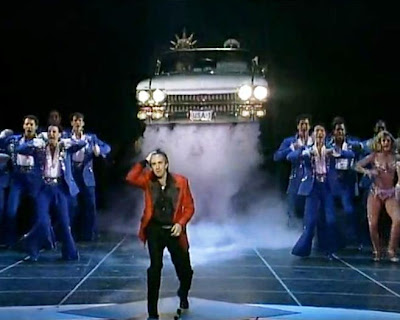 YouTube screen captures, Broadway production of "Miss Saigon", performed by Jonathan Pryce at the 1991 Tony Awards.
At the climax of the blockbuster Broadway show "Miss Saigon", the leading male star has a big production number. He's a con-man, a grifter, a pimp, and his exploitation of a tragic young girl is about to pay off big time.
As he savors this victory, he daydreams of his future in America. Night clubs, dancing girls, chocolate eclairs, champagne - visions of these luxuries dance across the stage until at last, the ultimate symbol of his American dream appears.
It's a 1959 Cadillac convertible, double headlights flashing as it descends through the clouds, its toothy grille glittering with a thousand LED lights. And as its sleek frame glides downstage toward him, you can see the liveried chauffeur and, perched on the back, a beauty queen, sashed and wearing a Statue of Liberty crown.
 Miss Chinatown's costume lights up and her car-seat elevates
The con-man flings himself on the polished hood of the car, fondles its headlights (wink wink!), writhes in obscene ecstasy, and then falls, as his vision evaporates into nothing.
Although I didn't create this effect, for five years it was my responsibility to fulfill the con-man's vision on a regular basis. The Cadillac car effect in "Miss Saigon" is an extremely complicated stage prop. At base, it's a "truck" or "wagon" - a platform hooked into the tracks of the automated scenery system embedded in the stage. The car itself is set onto the truck, and conveyed downstage for the scene.
To accommodate the cramped theatres on the tour's itinerary, our Cadillac was fore-shortened. It was chopped in half at the windshield, the front half stacked on top of the back half, mounted on a kind of hydraulic arm. As the wagon glides downstage, the car's grille and hood fold down in front of the rest of it, so by the time it emerges into the spotlight downcenter, the Cadillac appears long, sleek, and intact.
That's complicated enough, but in addition to that, it has flashing lights, spews dry-ice fog, and has two live actors inside.
Here's an article about our tour from a 1999 Honolulu newspaper that includes a small photo of our Cadillac.
If you think about this, you realize how difficult a piece of engineering this is. It has to have a frame that's flexible enough to hinge over itself, and yet sturdy enough to ballast the leverage. It must be strong, yet cradle its fragile, fleshy cargo within.
Through this steel frame threads a network of cables carrying electricity for lights, hydraulic lines, and data lines.
Separately, four-inch hoses and pipes feed through the car to route the fog from a port at the tailpipe that attaches to a steam boiler where baskets of dry ice are lowered.
Like the wires, hydraulics, and cables, the hoses must be slack enough to flex as the car is folded, yet taut enough not to drag or snag when the car is opened. All these parts must be carefully routed to avoid being pinched by moving parts, and padded against friction and wear.
And it must be able to do all these things while constantly functioning. Our show ran 8 days a week for over five years.
I was responsible for the lights and the fog, and also for connecting power and data. Everything plugged into a panel with a half-dozen multi-pin connectors and plugs, plus a big tailpipe to clamp the fog hose onto. This all took place in almost total darkness.
 This screen-capture inadvertently reveals the stagehand doing the same job I did. Look above Pryce's elbow
Lots of things could go wrong, but usually it was the fog hose. Sharp objects tore holes in it, snags stretched and broke it. Sometimes it slipped off the tailpipe. Holes spewed fog from the wrong place. On the other hand, kinks as the car unfolded or condensation water collected in low-sagging areas blocked the flow of fog. One memorable day, with a hot boiler, pressure from the dry ice drop blew the feeder hose off, shrouding all of backstage in impenetrable fog, but leaving the car's works starkly revealed on stage.

Maintenance was a constant. I used a lot of duct tape. I'd cut out a shredded section and rejoin the ends. We made a black velour "sock" to contain fog leaks. The critical link that hinged with the moving arm was too fragile for its task, so we searched the industrial zones of South Seattle and found a sturdier material. Every city we went we looked for newer and better hose.
The boilers needed maintenance, too. Elements burned out, wiring overheated, fuses blew. The huge steel bellies were drained and cleaned when we moved the show to a new city. Some cities had bad water - a silty, foul deposit collected that I flushed with a Shop-Vac.
 "Car Wreck - Classic Car Cadillac de Ville" - Image by Reinfried Marass
,
with thanksI remembered this experience vividly, after my recent stay in the hospital. I still have a Cadillac I'm responsible for. It's an aging one that works too hard; its system needs a clean-out and its tire-tread is thin. Its hose is kinked and snagged and sometimes clogged. A few wraps of duct tape have done the trick this time, but eventually, we're going to need to trim out some shredded sections and stick it back together.
To watch Jonathan Pryce perform "The American Dream" at the 1991 Tony Awards, go HERE.


