Sunday, June 14, 2009

Victorian Los Angeles - Part Two

We're continuing our story about Victorian Los Angeles, starting with a photo of this incredible house, the Hale House, rescued and restored by the Cultural Heritage Foundation. It's located at Heritage Square Museum, at 3800 Homer Street in Montecito Heights, north of downtown Los Angeles.

When Los Angeles decided to start preserving its past, it was spurred by the loss of a unique historical neighborhood in the center of downtown. Bunker Hill had been the residential neighborhood of the wealthiest and most elite founding fathers of Los Angeles - and then it became a dilapidated slum of aging Victorian rooming houses and tenements.

The Bunker Hill Redevelopment Project, begun in 1955 and still continuing to this day, cleared aging structures and replaced them with buildings to house government, corporate, and institutional pride.

Only a few people protested, and tried to rescue some of the historic structures. Finally, the City's department of Parks and Recreation donated land for relocating these structure to the Cultural Heritage Foundation.

Two structures, the Salt Box - built approximately 1880, and The Castle, a fantastic example of elaborate Queen Anne excess, were saved from the bulldozers and moved there, awaiting funds for their restoration.

Sadly, while awaiting restoration, both structures burned to the ground from a fire set by vagrants.

Despite that bitter loss the Foundation recovered, and followed its main mission - saving - on a shoestring budget. The Museum, now safely fenced, is home to nine structures in varying stages of restoration. It's located at the end of a quiet residential street just next to the 5 Freeway and the L.A. River. Drivers zipping past can see the fantastical structures, and wonder what they are. For a ten dollar fee, you can take a docent-led tour inside the houses. Photos are only allowed outdoors.

The Hale House, above, was built in 1887, only a few blocks away on Pasadena Street. It was donated to the Foundation in 1970 and moved here. It is considered a superb example of Queen Anne and Eastlake architectural styles.

Hallmarks of the Eastlake style include applied decoration such as the carved wooden panels and railings. Queen Anne style features assymetrical shapes, like the turret on the side and the small corner balcony; large wrap-around porches, and alternating textures like the scalloped shingles, inset panels, and decorative brickwork.

It's fully restored inside, and furnished as it would have been in 1899. The brilliant colors were reproduced from chips of the original paint found during restoration.

The Perry Mansion was built in 1876 in Boyle Heights, and features both Greek Revival and Italianate architectural styles. William Hayes Perry was a lumber tycoon, banker, and City Councilman.

The Perry Mansion is closest to the Museum's nearest neighbor, a small single-family bungalow. This rooster from next door is a frequent visitor.

The Valley Knudsen Garden Residence is an odd little house - a tiny cottage with an ornate mansard roof that looks like it belongs on a grander structure. The style was popular in France during the reign of Napoleon III, and much used by the architects who redeveloped Paris in the mid-Nineteenth century. This little house was moved from Lincoln Heights. The docent leading the tour told us that when it was moved from its foundation, they discovered a cache of empty liquor bottles stashed under the porch!

The Ford House was moved from downtown Los Angeles, and really isn't terribly unique as a structure - except for the amazing carved wood decoration. Lots of Victorian houses had applied wooden decoration, much of it factory produced and mass-marketed. The decoration at the Ford House, however, is one of a kind. The owner, John Ford, was a woodcarver and did all the woodwork on both the interior and exterior of the house himself, by hand.

The outside of the house is in beautiful shape, and it's set in a garden designed to be typical of a residential garden of its era - roses cover a trellis archway and lead to a family vegetable garden. The interior of the house awaits restoration. Walls and partitions dating from its days as a rooming house have been torn down, and the original plaster and lathe walls are exposed.

The other unique structures on the property include a late Victorian-gothic wooden church, an old horse barn, a train depot and an octagonal house. In the last, the old kitchen and bathroom are in their original unrestored state - which certainly gives you much food for thought about how our ancestors lived.


It's wonderful that the Foundation is doing such work, but at the same time, the place feels a little lonely, compared to Angelino Heights, which is home to real living families. Here, the historic houses sit silently, fenced away from their neighbors - whose small turn-of-the-century bungalows show the kind of haphazard alterations that were stripped away from these homes after they were donated to the museum. I wondered as I walked to where we parked - what if there were some way to help the owners of these small houses beautify them, and make the whole neighborhood an example of real historic preservation?


Victorian Los Angeles is all around us. We don't need to go to a museum to find it - or appreciate it. If you drive through the neighborhood, you'll find structures that look just as great candidates for restoration as the houses in the museum - like this example on nearby Glendale Blvd, with its elaborately carved gable in the Eastlake style, ornamental iron and shingled bay windows. Who knows what's beneath that asphalt siding?

Here in Echo Park, just at the foot of the hill Angelino Heights is built upon, is this house - a cottage similar to the Valley Knudsen Garden house, its mansard-roofed turret still sporting fish-scale shingles.

If you're in Los Angeles, go visit Heritage Square. They need your support.

Saturday, June 13, 2009

Pink Saturday - Pink Victorian cottage

Pink Saturday - Beverly, at the blog "How Sweet the Sound" hosts Pink Saturday. Let the color pink inspire you!

Pink Saturday comes in between two installments of posts about Victorian Los Angeles, so I thought I'd share this pink Victorian cottage, located on Kellam Avenue in Angelino Heights in Los Angeles's Echo Park neighborhood.

This pretty little cottage was built in 1899 by German immigrant John Fonnell. Look at the pretty floral wreath carvings and detail.

A few years later, Mr. Fonnell bought another house in the new seaside resort of Venice. Built in 1906, it was one of the first houses built by Abbott Kinney, and is now the oldest house still standing in Venice.

Its Moorish-domed turret once looked over the Cabrillo Canal, plied by gondolas floating beneath an arched Venetian bridge, as shown in this vintage postcard.

Did his family outgrow the tiny cottage on the hill and move to the west side, or did they just want a summer cottage closer to the beach?

Fonnell's Venice house is known today as the Venice of America House, and is located at 1223 Cabrillo Avenue. Its archways echo those of the remaining colonnades on Windward Avenue. The Canal itself is gone, filled in during the 1920s.

It may not have been pink when he bought it - but today it's a pretty color - peachy pink!

Both the Angelino Heights house and the Venice house are named Historic Cultural Monuments fby the City of Los Angeles. The Venice house is also listed in the National Register of Historic Places. Pretty cool that both of Mr. Fonnell's houses are listed - and even cooler that they are both restored, loved, and lived-in.

Go here to visit more houses in Angelino Heights, and see the vanished Victorian treasures that once graced Bunker Hill. If you'd like to comment please feel free to comment on this post or on the earlier one - I enjoy hearing what you have to say.

Stay tuned for Victorian Los Angeles - Part Two, coming soon.

Friday, June 12, 2009

Thematic Photographic - Road

Every week Carmi at Written, Inc. poses a theme for photographic inspiration. This week's theme is ROAD.

Illinois. Driving up I-57 in a cold November, snow flurries in the sky. That's a road.

Humboldt lilies

The other day a group of Topangans were talking together and we were trying to place where a certain family lived. My friend Anthea spoke up and said, "You know, it's that house on the boulevard just south of that big stand of Humboldt Lilies."

My friend Anthea is a garden designer, so of course this is a landmark she would notice. But I knew what she meant. And most of the other people in the group nodded - they also recognized it.

Humboldt Lilies are true lilies, native to California. "Lily" is a name English speakers tend to give to lots of big showy flowers, but true lilies, genus Lilium, are some 110 species of flowering plants that grow from bulbs. There are native lilies all over the world - Europe, Asia, and North America.
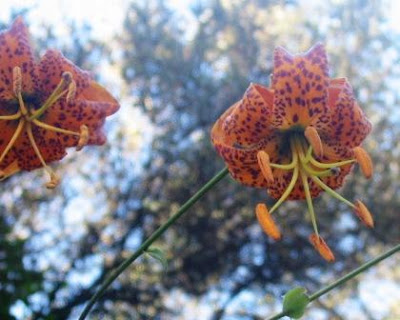
Humboldt Lilies send up one tall stem tall - up to nine feet sometimes - with leaves that grow in whorls around the stem.

The flowers are displayed in a scape at the top of the stem, a dozen or more blossoms. The and The Southern California subspecies is Lilium humboldtii subsp. ocellatum. Ocellated means having spots like little eyes, or oculi. Or like an Ocelot. Humboldt Lilies are orange with deeper brown or maroon spots.

The flower's form is described as a "Turk's cap" - where the petals recurve back sharply, giving the flower a turban-like shape.

Humboldt Lilies grow in mountain ranges, at elevations from 2000 to 3000 feet. They like good drainage and some shade. They bloom in June, and go dormant afterwards. Lilium pardalinum, Leopard or Panther lily, is a similar flower but grows in wetter soils by streams.

Humboldt Lilies are named after the European explorer and scientist Alexander von Humboldt. He was a contemporary of Napoleon, brother to the minister to the King of Prussia, and later served as diplomat for French King Louis Phillippe.

Humboldt was fascinated by bugs and other living things as a little boy, and also collected plants and shells. Although he was sent to school to study finance, he was interested in many things, and liked to travel. Soon he was joining scientific expeditions - first around Europe and finally in 1799 he joined an exploration of South America. He also explored Cuba, the United States south, and Russia.

His writings and essays were acclaimed, and he is said to have laid the foundation for the modern disciplines of geography and meteorology. He analyzed the magnetic properties of the Earth's poles, and studied volcanoes, theorizing about the igneous origin of certain rocks.

Between 1845 and 1847, Humboldt published his two-volume work "Kosmos" - a comprehensive study of the natural sciences, which made him world famous. It was timely - just around this time explorers of America's west had lots of newly-discovered bays and rivers that needed naming.

Humboldt Bay in Northern California was named by the sailors who discovered it. They were probably reading "Kosmos" on their long voyage around the Horn. His name was also given to a U.S. river, counties in three states, and four U.S. cities. There are at least a dozen plants and animals named after him.

Humboldt never married and had no children. Not much is known of his personal life, because he destroyed his private letters. He may have been gay, since he was known to have strong and emotional friendships with male colleagues throughout his life. He was a champion for the poor, an opponent of slavery, and his contribution to science is extraordinary. He died in 1859 at the age of 89.

One American political leader, Robert G. Ingersoll, said of Humboldt: "He was to science what Shakespeare is to the drama."

You can buy lily bulbs of all kinds, including bulbs of native American species lilies, at B & D Lilies in Port Townsend, Washington State.

The stand of lilies Anthea meant is in a shady bank on the east side of Topanga Canyon Boulevard, between the boxcar and Robinson Road. I took these photos here and at another stand on Red Rock Canyon Road, on the way to the park.

They're in bloom now.

Thursday, June 11, 2009

Victorian Los Angeles - Part One

What's the urban image that comes into your head when you think of Los Angeles, California? The tall high-rises of Century City? Palm-lined highways with curving interchanges streaming with cars? Low, sleek flat-roofed modern houses? Car-washes and coffee shops with curvy-shaped neon signs spikey pylons? Stucco-faced apartment houses surrounding swimming-pool courtyards?

The Foy House on Carroll Avenue

I bet you don't think of buildings like this.

Even though it's said that Los Angeles destroys its own history, the city still has an amazing collection of some of the finest examples of late Victorian domestic architecture. And you might be surprised to learn how deeply Los Angeles cherishes its late Victorian past.

The Sessions House on Carroll Avenue

This neighborhood high on a hill in Echo Park is called Angelino Heights. One street in particular, Carroll Avenue, boasts over thirty historic homes, beautifully restored - or in the process. Dating from the 1880s they include magnificent examples of Queen Anne, Eastlake, and Italianate architectural styles.

The Phillips house on Carroll Avenue

In 1886 subdivision developers William W. Stilson and Everett E. Hall. began to sell tracts on a hill west of downtown above Echo Park. It was easily accessible from the downtown business district by the Temple Street streetcar, it was appealing to families who wanted to get out of the increasingly noisy and bustling city. It was one of the first examples of a never ending phenomenon - urban flight.

Hall and his wife Nellie lived in this house, built in 1887, on Douglas Street.

A generation later, it was still a desirable neighborhood, and in the 1900s, homes in newer styles, such as Craftsman and California bungalows were built.

The Fonnell House on Kellam Street

Angelino Heights owes its current status to another Los Angeles neighborhood, one that's completely vanished.

Bunker Hill was the first desirable residential neighborhood in Los Angeles, and likewise a hilltop that separated homes from the noisy streets. Beginning in the 1870s, affluent Los Angeles residents built huge mansions and ornate hotels on the sloping streets. The Angels Flight railway ran down the hill, making it easy for the bankers and newspapermen to commute from their workplaces on Broadway and Main Street to their homes on the hill.

Photo from Los Angeles Public Library

One of the finest homes on Bunker Hill was located at 325 S. Bunker Hill Avenue. It was a 20 room Queen Anne house, three stories high, with a porte-cochere on the side of the house, and a tower with a mansard roof. It was the home of a family named Donegan, but its size and grandeur led to its being known as "The Castle."

Just like now, middle class families aspired to home ownership, and found that the further a neighborhood was from the center of town, the more affordable it was. Like many residential developments, Angelino Heights was settled by folks who aspired to elegant living, but couldn't afford the prices on Bunker Hill.

Photo from Library of Congress Historic American Building Survey

As the city expanded, Bunker Hill lost its status, but its decline was more severe, and the city had less tolerance for it. As the wealthy moved out, immigrant working-class people moved in, small businesses and tenement apartment houses were built among the old Victorian structures. The aging buildings, costly to maintain, were labeled "hazardous" by building inspectors. By the 1940s, Bunker Hill was being described as a "slum," "blighted," and harboring subversives. Hollywood noir films like "Kiss Me Deadly" and "Act of Violence" picturesquely exaggerated crime in its dark narrow alleys. 1951's "M" even placed the villian's lair in a Bunker Hill tenement.

Photo from Los Angeles Public Library

By the 1950's Bunker Hill was targeted for urban renewal. City boosters and the L.A. Times promoted downtown redevelopment, and ran stories exposing the unsightly slums. Old buildings and Victorian architecture became identified with crime and degradation - it was to be swept away and replaced by sleek, clean modern city-scapes. The downtown corporate interests and civic leaders envisioned a Bunker Hill crowned with office towers, broad public plazas, and proud institutions of elite culture - and firmly dismissed the idea of including affordable housing.

Leo Politi painting from Los Angeles Public Library

The first stage of the Bunker Hill Redevelopment Project cleared the houses, and graded the land. Only a few voices of opposition spoke against the project - among them artist Leo Politi, whose 1964 book Bunker Hill, Los Angeles: Reminiscences of Bygone Days includes his paintings of vanished Bunker Hill houses.

Photo from Los Angeles Public Library

The structures attracted many artists, and intrigued many others, and a small but vocal group of historians and preservationists fought to save these pieces of L.A.'s heritage. The Los Angeles Cultural Heritage Board was founded in 1962 in response to these activists, and designated the Castle as one of the City's first Historic Cultural Monuments. A court fight to save the structure kept the bulldozers at bay.

Photo from Los Angeles Public Library

This photo from 1968 shows The Castle, alone in a deserted landscape, contrasted with the new Union Bank building. The Recreation and Parks Commission had donated land where the rescued structure could be moved, and restored by the Cultural Heritage Foundation.

Sounds like a happy ending, huh?

Photo from Los Angeles Public Library

Sadly, while The Castle awaited restoration at its new location, it burned to the ground, along with another rescued house, the Saltbox. Vandals - perhaps vagrants looking for a place to sleep, or kids a place to party - lit a fire inside.

Perhaps this loss changed some people's minds. Angelino Heights residents began to realize the treasure they had. Interest in historic restoration grew. In 1983, their neighborhood was declared the first historic preservation overlay zone. Some thirty homes here are designated Historic Cultural Monuments by the City of Los Angeles.

The restorations are so successful these houses have attracted movie and TV producers, for use as locations. This house was used as the home of the heroines in "Charmed."

This house, with its witches-hat turret and fish-scale shingles, is a favorite.

Though Bunker Hill is lost, perhaps its loss spurred the preservation of Angelino Heights. And so there's our happy ending. Angelino Heights is a living, breathing, neighborhood, with its historic homes intact and appreciating in value.

To find out what the Cultural Heritage Foundation did after the loss of "The Castle," standby for Victorian Los Angeles - Part Two

Wednesday, June 10, 2009

Family Aroma Therapy

Our son is home, briefly, from college. A few years ago, we remodeled an office in our basement into a bedroom/bathroom suite a little more private than his old childhood bedroom next to ours.

Adulthood doesn't necessarily mean he doesn't rely on his parents for basic supplies when he's home. If he's out of something, he usually comes upstairs and takes ours. I don't begrudge him toilet paper - as long as it's not the last roll in the house.

But the week he got here, he stole my conditioner.

I have baby-fine hair that tangles easily, and I rely on my conditioner. I'm not particular about what shampoo I use, but I like my shampoo and conditioner to match - that is, I like them both to smell the same.

So I buy shampoo and a matching conditioner. My current combo is a house brand from my local "natural" pharmacy, and its label says it's scented with "Ylang Ylang and Ginger."

Whatever. It has a kind of pleasant medicinal/menthol/herby smell to me.

The first morning I noticed my conditioner was gone. I knew who the culprit was.

For some reason, I use shampoo at a greater rate than I use conditioner, so when I'm out of shampoo, I still have a little conditioner in the bottle. So even though I was annoyed, I was able to use the remaining conditioner from the previous pair. It was lemon-scented.

Another thing I'm sharing with my son during his visit home is the Volkwagen. I usually drive it, but while he's home he drives me to work each morning so he can keep the car during the day.

I always forget to ask him to return my conditioner until we're in the car. The conversation usually goes like this:

Me: "Hey, can you please return my conditioner?"

Him: [Sigh] "Sorry, I forgot. Sure. I'll do it when I get back home."

Me: "Why don't you stop at Vons on the way home and get yourself some, that way you won't need mine."

Him: [Sigh] "Okay."

But each morning, I end up smelling like Ylang Ylang, ginger, and lemons.

Yesterday, I squeezed the tube of lemon-scented conditioner, and nothing came out but air. I spent the day frizzy. Although, I smelled more coordinated.

Yesterday evening, [The Man I Love] gave me a ride home and we had to stop at the store. "I better get Son some conditioner so he'll return mine," I said "I'm totally out."

"I think he got some," said [The Man I Love]. "He got back before I left for work, and I saw a bottle on the counter."

"Let me just pick up some, just in case," I said, "for the next time he runs out."

So I grabbed the nearest bottle of the cheap stuff - Suave conditioner. Coconut scent.

When we arrived home, there was no bottle of conditioner on the counter. I figured Son had properly distributed both hair-care products to the rightful bathrooms. I left the Suave on the counter.

This morning, in the shower, I wet my hair and looked down for the shampoo - Hey!!! I still don't have any conditioner!!!!

So I got out of the shower, wrapped a towel around me and stormed dripping down to the kitchen to grab the coconut stuff.

Now I smell like mentholish Ylang Ylang and Ginger and Coconut. Kind of like an oily lounge chair at a beach resort in Australia.

After I finished and dried my hair I went down to the basement with the bottle of Suave. "Hey!" I knocked on his door. "Where's my conditioner?"

"Oh, Sorry. I'll get it." He went into his bathroom.

"I bought you this last night!" I said, brandishing the Suave. "Take. it."

"Actually, I bought some conditioner yesterday morning. I'm sorry I forgot to bring yours back upstairs." He handed me my conditioner and took the Suave.

Hey wait a minute! It felt suspiciously light. It's almost empty!

Gimme back the coconut stuff!

These are limones cocadas, Mexican candied limes stuffed with sweet coconut. Maybe I should buy lime-scented shampoo next time.

Tuesday, June 9, 2009

PROMPTuesday

Every Tuesday, Sandiegomomma posts a writing prompt to inspire the creativity of writers. Today's prompt:

What major decision(s) have you made in your life? What road did you take that led to something unexpected, or wonderful or not-so-wonderful-but-it-all-worked-out-in-the-end?


I was stale, I was stuck. I was in a rut. I had ambitions, but they weren't getting me anywhere. I was a freelance theatre technician, in the competitive world of New York City theatre, and each day I worked I worried about the next day without work.

And yes, I was sabotaging myself. I was indiscreet, I was impolitic. I drank with my coworkers and bosses. I slept with my co-workers and bosses. It was fun - like Edna St. Vincent Millay said, "my candle burned at both ends" - but I wasn't helping myself professionally.

I had just ended a doomed affair. He was a handsome older man - he had a brush with celebrity in his past that added to his cachet. He had a studio penthouse in a doorman building on lower Fifth Avenue - so unlike my life so far in New York, set in tenements and SoHo lofts, so each trip up the elevator to his rooftop terrace thrilled me. He admired my intelligence, he complimented my looks, he talked dirty about my body. He had long hair swept back from his noble forehead in a widow's peak, he had a neatly trimmed beard and strikingly turquoise eyes.

He was also a two-timing shithead.

After he'd left New York for the Pacific Northwest, I got a letter from him announcing his marriage to a woman whose name I'd seen autographed on photos at his desk. When I shared this with my friend Sophie over drinks in a SoHo pub she was sympathetic, but after the third round she confessed that he'd slept with her, too.

It had been one of those things, she said. She hadn't thought I was really serious about him.

Well - actually, I wasn't. When I look back at that time, that age, I realize that I deliberately chose to fall in love with men like that. Commitment-shirkers, wriggling out of my grasp, fleeing, eluding, betraying.

In a funny way, they were people just like me. I had done the same thing to nicer men, myself. I was just as afraid of commitment, just as duplicitous. That didn't stop me from feeling aggrieved. The ashes of my romance and the stall in my professional life depressed me and made me long for something different.

But I missed him anyway. I passed his door on Fifth Avenue. I could hear his voice among the drinkers at the White Horse Tavern on Greenwich Avenue. I could see his silhouette behind the glare of lights as I worked. I couldn't bear to be with Sophie anymore, and it was hard to know which loss hurt more.

I had a regular job at a theatrical lighting rental shop on Eleventh Avenue. I could work there by day and then run a show at night, when I had one. T
he bosses accommodated the shop crew's theatrical ambitions with a liberal policy about time off. Things were always slow on Wednesday afternoons, because so many of us would be off working matinees. You could always take a week off for a load-in, and then come back the following week. Some people left for months to do a tour, and then came back.

But the day to day work was dreary. We'd pull rental orders for traveling shows. We had to clean and test stage lights, bundle equipment, pack it in rolling crates, and then help load the trucks when they arrived to take it away.

When a rental order returned we'd have to count it in, check for damage. All the cable - thick black electrical cords - would be tangled in a giant mound, piled four feet high on the floor. It took all day to untangle the mess, coiling up each cable on a hand-wound crank, tying it neatly in two places with rough twine that smelled like burlap. The plugs on each end were marked with tape and magic marker and only harsh solvent could take that off. At the end of the day, I would be dirty, sweaty; hands black from the cable, the grimed adhesive from the tape, dessicated from the solvent.

After work, I sometimes went for a beer at the Landmark Tavern on Eleventh, just across the street from the shop's loading dock. Those who worked a show left in time to make a 7:30 half-hour call. Me, I took the subway home to my apartment, beery and dazed, wondering what he was doing in Seattle. One night I found a blinking light on the answering machine. Was it him?

No - It was a message from a designer I'd met once and sent my resume to. He'd worked with a friend of a friend. Would I be interested in a Master Electrician job? The show started in February, after a month of set-up. It would play the eastern half of the country the first six months, and then the western half. It was a good job - better money than I made now. Only I would have to leave New York.

And these New York streets. I would no longer see the phantom of my lost romance, lurking in every alley. I would no longer have to avoid Sophie.

I would have to give up my apartment, store my household belongings with my parents in New Jersey, fly to Florida for set-up. After that, I would spend a year on the road.

Living on a train. That's how the show traveled.

I decided to join the circus.

Monday, June 8, 2009

Roasted Gingko nuts

When I was young, my first job out of college was as a clerk typist at an import firm on Fifth Avenue in the Thirties, in Manhattan. I had an apartment in Greenwich Village, and sometimes if the weather was fine, I walked home from work, to save the subway fare - which at the time was $0.50.

I walked down Fifth Avenue, alongside Madison Square Park, where Broadway, slashing across the grid of Manhattan, crosses Fifth Avenue at 23rd Street. On the eastern side of the park rises the Metropolitan Life Tower with its golden cupola, and to the south, in a sliver of land between the avenues, the Flatiron building looms like the prow of an ocean liner steaming north.

It was autumn, and the trees in the park had pretty fan-like leaves that were brilliantly golden. But I began to notice on my evening walks that something smelled.....not right.

The trees were Gingko trees - gingko biloba - also known as the Maidenhair tree. Gingkos are from China, and have existed in this form since prehistory.

Gingkos are dioecious - meaning that there are separate male and female plants. The park was planted with both - and so the female trees bore fruit. The fruit are like small, golden-orange plums, with soft flesh surrounding a central nut. Pretty - but the flesh contains butanoic acid. Text books may say butanoic acid smells like "rancid butter" but what it really smells like is Puke! And Poop! Fallen fruit on the sidewalk makes pedestrians inspect the soles of their shoes, wondering if someone failed to curb a dog.

In American cities with large immigrant populations it's not unusual to see elderly Asian people in the parks in the autumn, picking gingko fruit off the ground, and cleaning off the stinky flesh to save the nut beneath. Gingko nuts are prized in Asian cuisine.

Gingko nuts look like bigger, rounder pistachios. Some people shell them and stirfry the fruit, but the only way I've had them is roasted in the shell. The roasting makes the shell brittle, and you can crack them open with your fingers. Inside the plump nut is encased in an inner, papery shell that you can peel off if you want. The meat itself is a nugget of waxy, golden-green flesh. It's not crunchy, but soft - the texture is something like a Gummy-bear. The taste is subtle, starchy-sweet, a little like a chestnut, with a touch of bitterness.

They don't taste stinky!

In Japanese they are called ginnan. They are good served with sea-salt and cold sake - or with a glass of Prosecco, as we ate them before dinner last night at the home of dear friends.

Sunday, June 7, 2009

Deadly beauty

When you're out hiking in the Santa Monica Mountains, looking for wildflowers, your eyes become accustomed to small details. In this dry, hot habitat, plants tend to be small and wiry; woody and twiggy. They are often resinous, with sticky or rough surfaces to prevent moisture from evaporating, and narrow leaves to expose as little surface area as possible to the hot sun. Flowers tend to be small - large, delicate petals don't have staying power in hot, dry winds. Plants have small tubular flowers, and hide their nectar away, saving it for the hummingbirds.

Every once in a while, though you encounter something that looks like it's in the wrong habitat, and you go WTF??

Datura wrightii is a vigorous yet ungainly plant, growing about three feet tall and sprawling out about five feet around. It has thick stems, and large thick, almost meaty grey-green leaves. Its most striking feature, however, are its flowers - huge trumpet-shaped white blossoms, lightly touched with lavender, facing up to the sky. The flowers are intensely fragrant, especially in the evening.

It looks like a petunia on drugs.

That comparison is apt. Datura wrightii is also known as Sacred Datura. Like its close cousin, datura stramonium, it is a hallucinogen, and contains atropine, hysoscomine, and scopolamine. It induces both visual and auditory hallucinations, and delirium. Other common names for these plants are Angel's Trumpet, Devil's Trumpet, crazy tea, and Locoweed.

Native Americans used it for ceremonies and rituals - prompting early Western settlers to call the plant "Indian whiskey," for its intoxicating properties. Navajo people have a saying -"Eat a little and go to sleep. Eat some more and have a dream. Eat some more and don't wake up."

Datura and was a very important ritual plant to the native Tongva and Chumash people who were the early inhabitants of these mountains. At the age of eight, Chumash boys were given a tea-like preparation of datura, called momoy, as a rite of passage into adulthood. The visions they saw while high gave them guidance for their future lives. Boys made carvings depicting their hallucinations, to keep spiritual talismans all their lives. Momoy is also the name of the goddess associated with daturas, and because it was such a powerful medicine, she is also associated with medicine and healing. She is also associated with the moon - and why not, with such striking and luminescent round white flowers?

Now, Topanga has certainly been associated with the "drug culture," but I had no idea our hippie heritage went back that far. Unhappily, abuse of datura sometimes occurs among teenagers in the American Southwest, who end up in emergency rooms.

Every part of the datura plant is toxic, including the seeds, which are contained in spikey pods that burst when dry.

Experimentation with Sacred Datura can be extremely dangerous - so don't do it! Another common name, Jimsonweed, comes from an actual incident of mass poisoning. In 1676, in the settlement of Jamestown, Virginia, a group of British soldiers gathered some tender young datura leaves and made a salad of them. A 1705 historical account describes what happened next:
"they turned natural fools upon it for several days: one would blow up a feather in the air; another would dart straws at it with much fury; and another, stark naked, was sitting up in a corner like a monkey, grinning and making mows [grimaces] at them; a fourth would fondly kiss and paw his companions, and sneer in their faces with a countenance more antic than any in a Dutch droll."
Datura's effects on the body include extreme dilation of the pupils, flushed and dry skin, the inability to pee or void one's bowels, and a rapid, irregular heartbeat. In addition to the delirium, scopolamine can temporarily blind you, causing some people to get into accidents because they can't see where they're going.

The effects sometimes don't occur until several hours after ingestion. Because of this, and because the amount of toxin in each plant varies, it's easy to overdose.

Datura wrightii isn't a common garden plant, but several other datura family members are used as ornamentals. One very common and beautiful cousin seen quite frequently in California gardens is Brugmansia suaveolens, a small tropical-looking tree called Angel's Trumpet, for its pretty melon-colored downward facing trumpets. There have been incidents of unintended datura poisoning when gardeners injest leaves of brugmansia by mistake.

This datura plant is growing beside a trail in Red Rock Canyon Park. It doesn't look so scarey, does it? But it's just another reminder that our everyday world contains hidden secrets.